
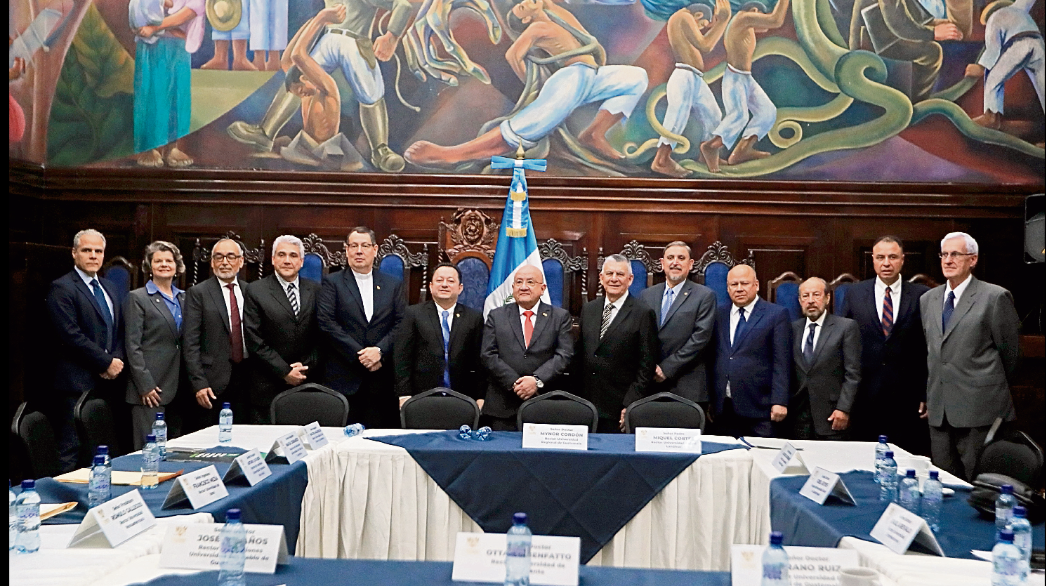
The 17 rectors of the universities operating in the country were summoned this Friday, June 12, by Luis Contreras, president of Congress, for the election of the president of the nomination committee for Comptroller General of Accounts.
The appointment was set for Wednesday, July 15 at 11 a.m., in one of the rooms that operate in the Legislature, which in the opinion of observers already suggests a public vote that will give greater transparency to the process.
The plenary session of deputies has already convened the nomination commission that must elect six candidates to lead the Comptroller General of Accounts (CGC), a final decision that also falls to Congress.
This is the last second-degree election in 2026, after the institutional renewal of the Supreme Electoral Tribunal (TSE) and the Public Ministry (MP), which coincided with the change in the Constitutional Court (CC).
The presidency of the postulator, although it represents a vote, is vital for the direction of the sessions, since the frequency of the sessions depends on said commissioner, as well as the potential location for the safekeeping of documents, which could also facilitate or complicate the work of observers and the press.
Sources close to the universities have confirmed that Walter Mazariegos, rector of Usac, would be seeking the presidency of said candidate, with the support of at least six rectors who would seek to place him in the position.
On Wednesday, July 15, at 11 a.m., the 17 rectors of the country’s universities are summoned to the @CongresoGuate to elect the president of the CGC candidate. A group of academics seeks support to hand over the presidency to Walter Mazariegos of the USAC. pic.twitter.com/mkaTGajJqW
—Douglas Cuevas (@dcuevas_pl) June 12, 2026
The CGC becomes relevant this year, since in addition to being the entity in charge of oversight, the change will occur in a pre-electoral context, and said institution is in charge of issuing documents that become essential requirements for the registration of candidates before the TSE.
They expect transparency
Mynor Lorenzo, an analyst with the organization Guatemala Visible, sees it as positive that the president of Congress calls the Rectors’ Forum to ensure that constitutional deadlines are respected.
“It is also positive that this call was made publicly. This shows transparency so that each stage of the process can be followed, this gives confidence,” he said.
He considered that leaving the election for July 15 allows the phases of the process to be completed, by adding greater room for conversations for the rectors in the search for agreements.
“The date seems correct to us, since it is within the times dictated by the law and in some way it is prudent, almost a month, so that the rectors can dialogue, seek the participation of candidates and achieve consensus to reach a majority,” he said.
For the expert, the president of the candidate must demonstrate “merits of morality, ethics and independence,” which will allow him or her to have the professional and moral tools for a good job.
“The president must have credibility to sit down and talk with the commissioners, so that he can seek consensus and demonstrate that the decisions are independent of any external power that seeks to influence the payroll,” he indicated.
They reject Mazariegos
For his part, Pablo Muñoz, a member of the Alliance for Reforms, said that if the group of rectors sympathetic to Mazariegos insist on promoting him as president, they will do “irreversible” damage to the process.
“The figure of Walter Mazariegos is more unsustainable after a second fraud. A vote in favor of him would have a greater political cost, without considering that there are private universities related to him with the apparent intention of influencing the second-degree elections,” he said.
The observer highlighted that the president of the commission is a reflection of the type of work that is expected, giving as an example a questionable performance in the candidate for TSE magistrates that Mazariegos himself headed at the beginning of the year.
“It was express – the TSE candidate -, without quality or content. The effective working hours may not have even reached 24 hours. About 20 minutes to review a file is not the best,” she recalled.
The opposite is true with the work of the 2024 applicants, who were led by Miquel Cortés, from Universidad Rafael Landívar (URL), and Raúl Arévalo, from Universidad Internaciones.
“Let us remember that in 2024 two independent rectors presided over the Cortes nominations. This makes it clear to us that the presidents are key because they can offer a good headquarters for the work of the commission and transparency,” he concluded.