
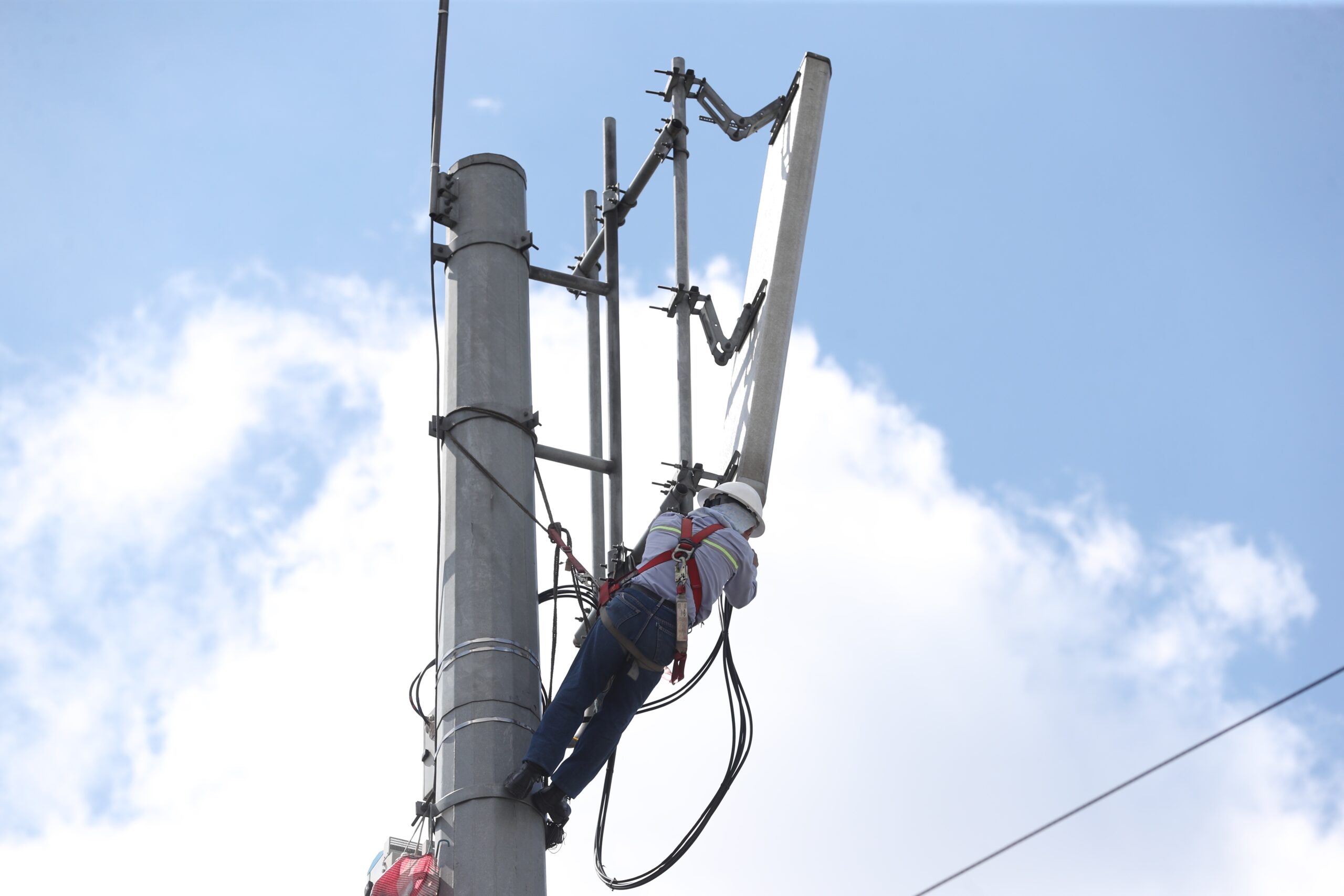
This June 18, the Ministry of the Interior (Mingob) began testing a new system to block telephone, internet and other communications signals in the country’s prisons. However, the strategy faces at least three obstacles: criminal technology that has evolved faster than state technology, allegations of corruption within the Penitentiary System and legal loopholes to involve all internet providers.
The Vice Minister of Information and Communications Technology, Karen Ortiz, reported on Monday, June 15, that the equipment used for the tests has already entered the country and been installed, while the programming processes with service provider companies are concluded.
“The equipment comes from abroad and we are finalizing programming at the systems level that must be done with the service provider companies,” explained the official, who also indicated that they are working on about 20 technical aspects related to the inhibition of signals within the detention centers.
For security reasons, the details were not disclosed, but it was officially known that the technical tests were carried out in 10 prison centers with temporary equipment and specialized software.
In February 2026, the then Vice Minister of Technologies, William Cameros, calculated that the implementation of signal inhibitors would cost Q2 million per month to cover 15 preventive centers.
Operational equipment, but limited to 3G technology
During a summons made this Thursday, June 18, by Deputy José Chic, the Deputy Director of IT of the Penitentiary System, Daniel Edelmann, revealed that there are currently 53 signal blockers distributed in five of the 15 prison centers in the system and that all of them are operational.
However, he acknowledged that these devices were designed for technologies that have already been left behind.
“The signal blocker currently implemented covers up to 3G frequencies and we know that the technology we have today is 4G and 5G, so it does not block it completely,” he stated.
As he explained, this limitation is precisely the reason why the Government is carrying out tests with a new generation of equipment that seeks to block networks, Wi-Fi, radio frequencies and other forms of communication currently used.
The statements coincide with warnings made by Ortiz about the need to update State tools against technologies detected during searches, including wireless connections and satellite internet.
Starlink, 5G and high-end phones
For Chic, the problem is that criminal structures have managed to modernize their communication systems faster than the State.
The congressman recalled that the equipment is already obsolete because they continue to find Starlink devices, which exceeds what he describes as “attempts” by the authorities to put a limit on them.
The legislator maintained that groups linked to organized crime continue to use smartphones and other mechanisms to maintain illicit communications, and went further by questioning the authorities’ response.
“If there is technical capacity to restrict content or signals in other areas, such as football events, the question is why it has not been applied with the same effectiveness to combat crimes that continue to be coordinated from prisons,” questioned Chic.
“It’s not just signal blocking; we also have to evolve in other controls, such as X-rays and scanners,” added Eddy Morales, former director of the Penitentiary System, when asked about the matter.
The problem goes beyond technology
Beyond the discussion about 4G, 5G networks or satellite internet, Chic insisted that one of the main challenges continues to be preventing criminal structures from finding support within the prisons themselves.
As indicated, the presence of technological equipment, antennas and communication systems within prisons necessarily requires some level of internal collaboration.
“When Starlink antennas have appeared inside prisons, there must be the participation of guards from the Penitentiary System,” he assured.
The deputy also pointed out that any investment could fail if corruption is not combated within the Penitentiary System.
“There is no point in investing millions in technology if someone can turn off the equipment, cut a cable or allow devices to enter,” Chic said.
“The Penitentiary System lacks efficient human resources; if there is corruption, technology is useless,” Morales added.
In his opinion, these internal extortion mechanisms are part of a criminal economy that also facilitates illicit communications and criminal operations abroad.
Finally, Morales warned that, without effective capacity and control, the current measures will not have a sustained impact. “Without trained personnel and effective control of the blockades, we are going to return to the same old adventures,” he emphasized.
A pending legal loophole
Ortiz also pointed out that the Government presented observations on a bill that seeks to transfer blocking responsibilities not only to telephone companies, but also to internet providers.
However, he acknowledged that there is an additional difficulty, because Guatemala does not have a complete registry of internet providers, which complicates the supervision and application of blocking measures.
The official explained that the solutions analyzed include mechanisms that could be applied directly from the servers of the supplier companies, without the need to install visible equipment inside the penitentiary centers.
The Superintendent of Telecommunications, Herbert Rubio, pointed out that the current regulations face a “double problem” in the identification of users of mobile services, since, as he explained, the user provides the data at the time of contracting the service, but the operator would not have the obligation to verify them.
“There is no record that allows us to establish today who owns a terminal,” he stated.
Rubio also stressed that, in legal terms, there is no express obligation for operators to block the signal in prisons.
“We have no obligation to block signals in prisons,” he indicated, although he added that “we could legally analyze actions, but that must be reviewed.”
Furthermore, he explained that, although companies have assigned frequency bands, it is not possible to determine with certainty which ones are being used at a specific time.