
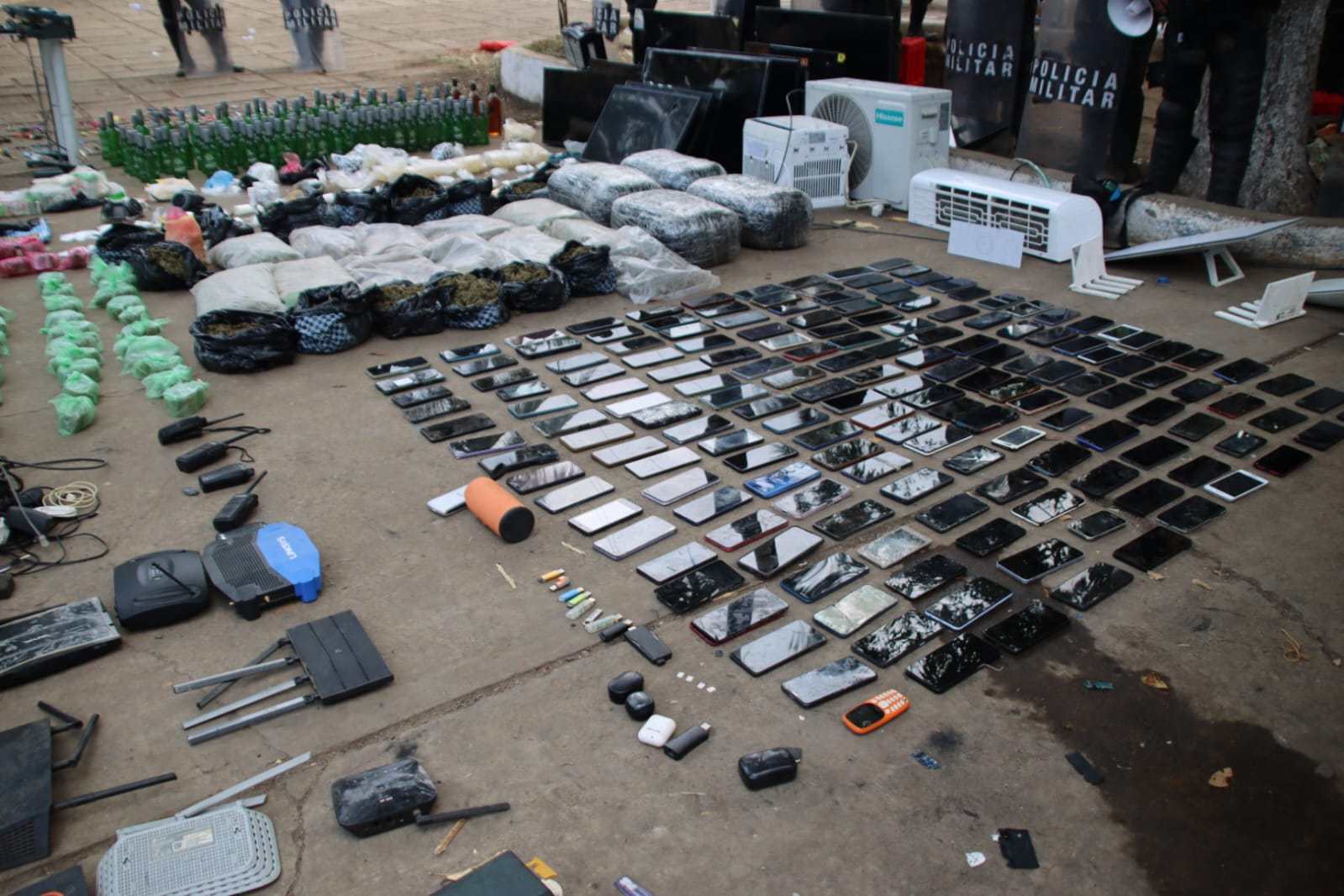
The Vice Minister of Technology, Karen Ortiz, reported that an initial investment of Q10 million to implement signal blocking systems in the eight detention centers with the greatest gang presence.
According to the financial projections presented, the amount of Q10 million is intended to cover the operation of the system for a period of two years. The vice minister explained that this budget would allow the deployment of the new system.
“We are talking about around… about a million and a half (per center),” an amount that, according to him, could vary slightly depending on the geography and dimensions of each prison.
The official assured that this amount is viable within the current planning, although, if additional funds are required, it is contemplated to verify surpluses in other ministries to make the necessary transfers.
Technical results
The announcement of this investment comes after a “proof of concept” carried out in the Zacapa prison, which it started on June 18 and concluded on July 7. Ortiz explained that a company, whose corporate name was not described, did the initial tests at no cost.
The official explained that it is a company from El Salvador, which did not specify whether it has any services implemented in the Terrorism Confinement Center (Cecot), a maximum security prison located in Tecoluca, in that country.
Ortiz stated that the technology managed to block the telephone and internet signal. “We made around 80 call attempts at different points… they were unsuccessful. That is, the connection was not achieved. Nor could the data link be made,” he specified.
The proposed system requires remote monitoring mandatory by the National Civil Police (PNC) and the Ministry of the Interior (Mingob). In addition, it must have a mechanism for automatic alerts that notifies authorities in the event of vandalism against individual devices, designed so that damage to one device does not disrupt the operation of the rest of the blocking network.
Regarding physical protection, the technical specifications will require a robust infrastructurethrough the use of solid and cast bases, installed at a higher height to make possible sabotage by inmates difficult.
The official expanded details during a summons in the Congress of the Republic. The deputy Jose Chic He questioned the effectiveness of the current strategy and pointed out that extortions and hitmen orders continue to come out of centers such as those in zone 18, Pavoncito and Matamoros.
The congressman criticized that, despite having a budget of Q200 million allocated by the anti-gang law almost a year ago, “not a single cent” has been spent to stop these communications.
The fact of not immediately covering the 24 centers, as Ortiz explained, responds to the fact that the selection was made in conjunction with the First Vice Ministry, based on the presence of gangs, which constitute the main focus to reduce the coordination of crimes and extortions.
He admitted that it is necessary to expand the system to the entire prison network, but that this depends on the results of the financial table and budget availability.
Legal actions against illegal internet
As a complementary part of this investment, Mingob will begin a legal offensive against the use of internet routers in prisons. The vice minister warned that, through the IP address, telephone companies can identify those responsible: “Complaints are going to begin to be filed against the people who are responsible for the ownership of the routers.”
For the estimated investment of Q10 million destined for eight penitentiary centers for two years, the Ministry of the Interior plans to establish bidding bases with specific technical requirements to ensure state control.
The objective is that the new system does not depend on guards who can turn it off, but rather has remote alerts. If a device is vandalized, the system will notify you immediately and the lock will continue to operate in the rest of the prison, to prevent a physical attack from nullifying all security.
Regarding physical protection, the technical specifications will require a robust infrastructurethrough the use of solid and cast bases, installed at a higher height to make possible sabotage by inmates difficult.
Without video surveillance cameras
While the blocker project advances, the Penitentiary System faces the challenge of reactivating its camera network, which is currently inoperative in almost all prison centers.
The deputy director of the Penitentiary System, Melvin Rosales, admitted that today they only have control of cameras in two prisons; one of them is the Salamá Preventive Center.
However, under the framework of Decree 5-2025, the institution has set a goal that for September 2026 All centers have general surveillance systems under state control, after the contract with an external company has expired.
Ortiz recognized that one of the biggest obstacles is the speed of technological advances, such as 5G and 6G, which is why he stated that a law is necessary that forces telephone companies to collaborate and that allows the State to establish the technical rules in the tenders so as not to depend on what the companies want to offer.
Read also: Jail escape reveals that 20 prisons are without cameras in Guatemala