
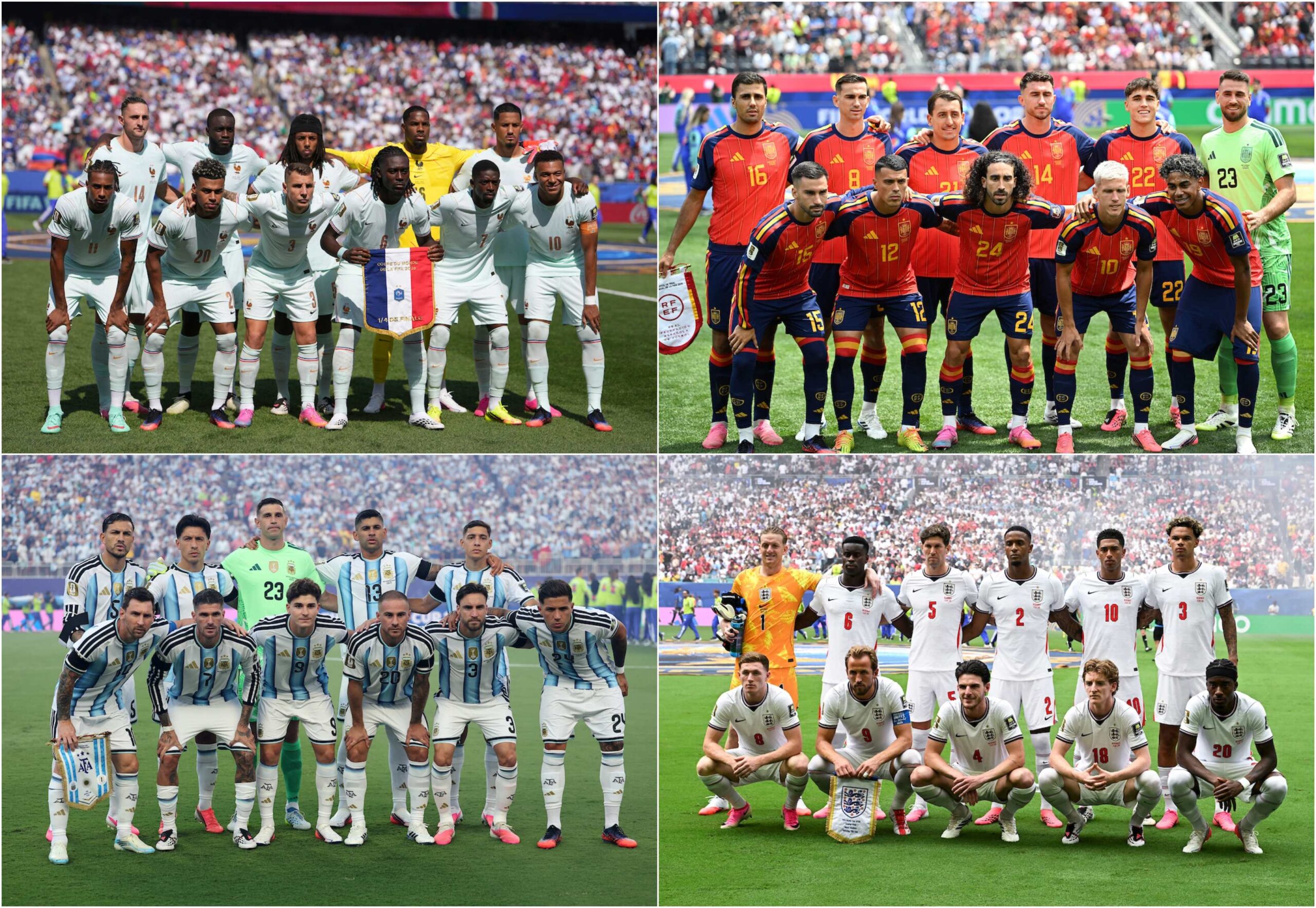
The presence of Argentina, France, Spain and England between the four best teams in the 2026 World Cup raised a question among fans and analysts: how did the four teams that occupied the top positions in the FIFA World Ranking before the start of the tournament coincide in the semifinals?
The answer combines two factors. The first was sporting: the four teams advanced thanks to their results. The second was regulation: the official draw procedure and the draw design prevented them from facing each other before the semifinals, as long as they finished first in their respective groups and passed each knockout round.
for the first time Since FIFA created its world ranking in 1993, The four best-placed teams before the tournament simultaneously reached the semifinals of a World Cup. Argentina, France, Spain and England headed the ranking published on June 11, 2026, the last one before the start of the competition.
The draw changed the role of the ranking
The 2026 World Cup is the first with 48 teams. The new format expanded the knockout phase to 32 teams, made up of the first two in each of the 12 groups and the eight best third parties.
The expansion of the tournament forced FIFA to modify the draw procedure to organize a larger draw.
The official draw document states that, “to ensure competitive balance”the tournament was divided into two separate tables until the semifinals. In addition, it determines that the two best-placed teams in the ranking prior to the World Cup are assigned to opposite sides of the draw and applies the same principle for the third and fourth classified teams.
FIFA itself adds that, if these teams finish first in their groups, they will not be able to face each other before the final rounds of the championship.
Consequently, The ranking is no longer solely a statistical reference to become a determining element in the formation of the table and in the distribution of the main seeds.
A system similar to that of tennis
The mechanism is reminiscent of the one used for decades in tennis tournaments, where the main seeds are distributed in different areas of the draw to avoid confrontations in the first rounds.
Something similar happens in the World Cup. Once the draw has been carried out and as long as the seeds meet the objective of winning their groupsos, the route to the final rounds is defined by independent sectors.
This is what happened in the 2026 World Cup.
Argentina, France, Spain and England They topped their respective groups and advanced through different routes until completing the semifinals between France and Spain, on the one hand, and England and Argentina, on the other.
The system did not guarantee the semifinals
The distribution of the table did not ensure that the four best Ranking teams will reach the semifinals.
The only thing that was avoided was a confrontation between them before that instance, as long as they finished first in the group and they will overcome each of the eliminatory rounds.
Any defeat against another rival It would have completely altered the picture.
In fact, several teams considered favorites were eliminated before the semifinals. Brazil, Germany, Portugal and the Netherlands did not manage to advance until the penultimate round, which shows that the system ordered the route of the main seeds, but it never protected them from elimination.
The sporting merit continued to be the decisive factor.
An unprecedented fact since the FIFA ranking existed
Comparisons with Mexico 1970 and Italy 1990 They emerged quickly because both editions also brought together only world champion teams in the semifinals.
However, there is a fundamental difference. When those tournaments were held, FIFA had not yet created the World Team Ranking, which was officially introduced in August 1993.
Therefore, there is no institutional parameter equivalent that allows us to affirm that the four semi-finalists of those editions occupied the top positions in world football.
Instead, the The 2026 World Cup does offer that possibility.
The four teams that topped the FIFA World Ranking Before the tournament they ended up in the semifinals, an unprecedented scenario since the organization published its official ranking.
More than a statistical classification
The 2026 World Cup left a consequence that probably will mark the next editions of the tournament.
The FIFA World Ranking It stopped being only an indicator of the recent performance of the teams to become an element with a direct impact on the architecture of the competition.
The lottery procedure defined the location of the main seeds and prevented them from crossing before the semifinals, as long as they met the sporting requirements established by the regulations.
Then, as happens in any World Cup, it was the results on the field of play that determined who took advantage of that route to reach the penultimate round.
The new format did not ensure the success of the favorites, but it did give the ranking a competitive importance that it had not had in previous world championships.