

The figure of the highest ecclesiastical authority always goes down in history. But in the case of Pope Francis his brand has left a deeper mark.
Millions of people in the world followed them promptly during his pontificate and many others met him a little more through the films that have approached his figure.
Jorge Mario Bergoglio chose Francisco’s name, when He was appointed Pope in 2013, in honor of the saint, a austerity symbol and closeness to the poor. His coherence, his closeness and intention to open the Church to the 21st century, gave him an outstanding place in the history of the two hundred and sixty -six popes that have held the highest ecclesiastical position.
He was the first American Pope, also the first of the southern hemisphere and also chose to get rid of certain privileges conferred by his position, which led him to obtain a particular look from the rest of the world.
The Vatican Apostolic Palace did not want to have as a residence, as head of state, but the Santa Marta house, a simple residence for priests. He did not even want to wear the red shoes that the pontiffs usually fit, he preferred to continue with his own. Football fan of football, provided that time allowed it, followed the matches in the shared dining room of his residence.
Before the conclave that would give him the high position, the presentation of then Jorge Mario Bergoglio, was articulated around a central idea: “The Church is called to leave itself and go to the peripheries, not only the geographical ones, but also the existential peripheries.” Once named Pope acted in line.
Francisco was close to the poor, prisoners and migrants. Aware of the times when his papacy, the digital era, the Pope Francis created the Secretariat of Communication in the Vatican, attending to new technologies. Thus, it put the traditional diffusion level Vatican radiothe newspaper L’Osservatore Romano and the Twitter account that Benedict XVI had already opened in 2012.
These media also incorporated Instagram and YouTube. From the @Pontifex account million people have been able to continue, day by day, all the events of the maximum pontiff.
In 2013 Pope Francis was chosen by the magazine Time as one of the 100 main leaders and in the same year his photograph was covered in The New Yorker.
A few months later the magazine Rolling Stone He incorporated, for the first time in his history the image of a Pope and did it with the title of a song by Bob Dylan The Times they are a-changin (Times are changing).
Such historical figure could not go unnoticed, nor for the seventh art. Fiction films and miniseries that have recreated their history or documentary feature filmsgive free rein to an outstanding personality, unforgettable in every way. Another way to show the legacy of a maximum leader who was very aware of the time he had to live and never forgot his purpose, serve others.
Francisco. Father Jorge. (Beda Docampo Feijoo2015)
In this fiction feature film, the Argentine actor Darío Grandinetti gives life to his compatriot making a vital tour of the Holy Pontiff.
Through the Pope’s meetings with a Spanish journalist who embodies actress Silvia Abascal, we know the youth avatars of the then Bergoglio, his family life or the circumstances of the Argentine dictatorship that leads him to act and take sides.
Call me Francis (Chiamatemi FrancescoDaniele Luchetti 2015)
Netflix’s original miniseries was originally a film, but the abundance of Bergoglio’s experiences demanded a series of four chapters.
It supposes the approach to a missionary and committed spirit, from his youth – Papel played by the actor Rodrigo de la Serna, to his senustud and his appointment as Pope – where the role is interpreted by the actor Sergio Hernández.
Pope Francis. A man of word (Win Wenders and David Rosier2018)
This documentary film is the close and personal look of the filmmaker Win Wenders, fascinated with the personality of the Pope that leads him to accompany him on different trips.
The film is the reflection of the concerns of the pontiff for the real problems of the world: the environment, vulnerable people or consumerism and church response to these challenges.
The two potatoes (Fernando Meirelles, 2019)
Unanimously praised by specialized criticism, this film was masterfully interpreted by Anthony Hopkins, who gives life to Benedict XVI, and Jonathan Pryce, in the skin of Jorge Mario Bergoglio.
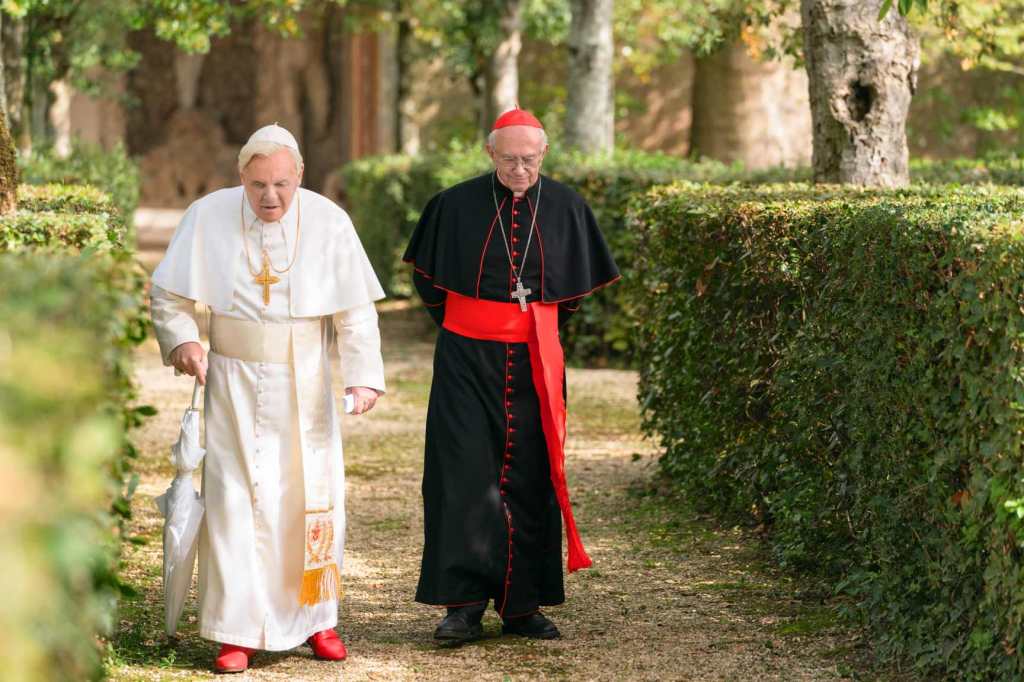
This film gives the opportunity to attend the moment when the pressing was glimpsed the exit of the first and the entrance of the fresh and renewed air of the second. An interpretive duel with a delicate background, the important crisis that the Church lived at that time of inflection and that should be resolved efficiently.
Amen. Francisco responds (Jordi Évole and Màrius Sánchez, 2023)
A very particular portrait of Pope Francis from the questions of ten young Hispanics in an an hour and a half encounter.
The closeness that the maximum pontiff always expressed to people is forever recorded in this documentary where we speak without taping about sexual diversity, abortion, pedophilia, immigration or loneliness. The figure of Pope Francis is already eternal. From the day of his choice, his name was already part of the story. But his personality and his church opening project to the historical moment that he had to live makes his memory become indelible.