
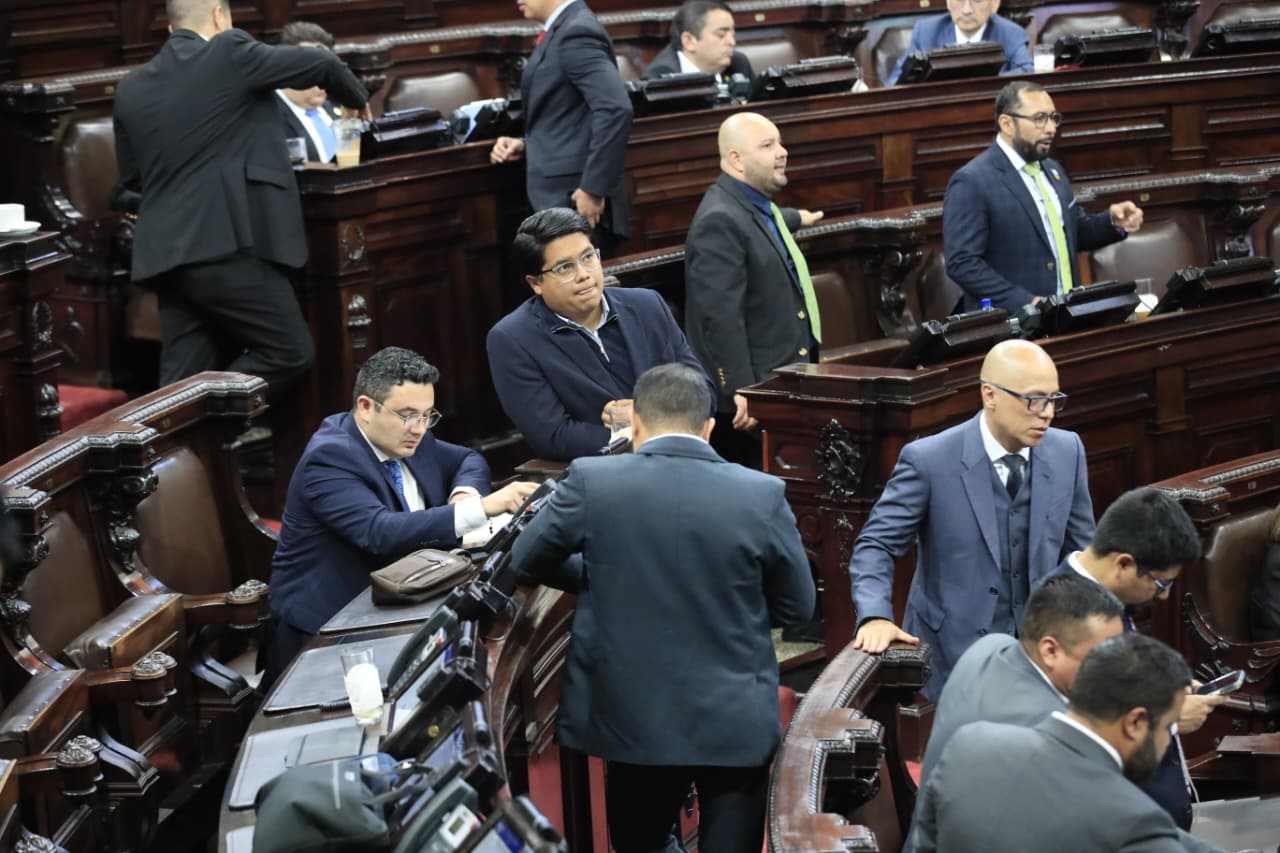
With 125 votes in favor, initiative 6593 was approved this Tuesday in its third debate, through which the Comprehensive Law against Money Laundering or Other Assets and the Financing of Terrorism is created, presented to Congress by the Executive Agency in September of the previous year.
As established in said initiative, the objective of the law is to modernize and unify in a single legal framework the regulations in force in the country to prevent and counteract these crimes, and adjust Guatemalan legislation to international standards established by the Financial Action Task Force (FATF) and various international agreements of which Guatemala is a signatory.
Deputies from different legislative blocks have indicated that the approval of this law “It is of utmost importance for the protection of the national financial system and to prevent Guatemala from being included in the gray list of countries that do not comply with the standards established in financial matters and in the fight against these crimes.”
In 2027, the country will be evaluated by the Latin American Financial Action Group (Gafilat). For this evaluation it is necessary to have an updated standard on the matter, stated Jorge Ayala, president of the Economy Commission.
“We believe that it is part of the commitments that as the state of Guatemala we must have before the Financial Action Group, Gafi, which will visit the country in February 2027. What this initiative does is update the two legal bodies that deal with the issue of money laundering and the financing of terrorism in a structure that also changes the risk-based approach and clearly establishes the functions and responsibilities of the obligated persons and also of the financial intelligence units,” Ayala stated.
Within this initiative, structural changes are introduced in the country’s anti-money laundering system. In addition, it seeks to strengthen the preventive system and the sanctioning regime, as well as improve institutional coordination.
The law also introduces the internationally used model called “risk-based approach”, which requires institutions to identify, evaluate and mitigate money laundering risks.
Within the opinion issued, amendments were also incorporated aimed at improving its practical application and changes were introduced to harmonize the initiative with other national laws and international standards, in order to avoid legal contradictions.
The main aspects contained in the law are:
- Modernize anti-money laundering legislation
- Incorporate a risk-based approach
- Specify key definitions of the preventive regimen
- Adjust the scope of obligated subjects
- Strengthen institutional coordination and supervision
- Align Guatemalan legislation with international standards
Cybersecurity Law is withdrawn from the discussion
After the approval of the anti-money laundering law, the deputies began to discuss bill 6347 in the third debate, that proposes the creation of the Cybersecurity Law.
Deputy Elmer Palencia, second vice president of Congress, presented a privileged motion so that the opinion of said bill be returned to the National Security and Economy Affairs committees of Congress, which had issued a joint opinion, since, according to the congressman, “it contains several weaknesses and does not have a delimitation of the powers that would correspond to each of the entities in charge of its application.”
“We do not need just any law. A poorly designed law can generate a false sense of security without building real prevention, coordination and response capabilities. The initiative under discussion recognizes the importance of the issue, but presents important weaknesses. The main one is that it mixes different subjects: cybersecurity, cybercrimes, institutional response, without delimiting powers. This does not strengthen the State, it generates confusion and weakness,” said the parliamentarian.
Deputies from several legislative blocks supported Palencia’s proposal, and stated that Congress “should not respond to the current situation,” making emphasis on the data “hacking” that occurred recently in the General Directorate of Arms and Ammunition Control (Digecam).
Finally, The congressman’s proposal to remove the cybersecurity law from the agenda was approved with 94 votes in favor, Therefore, it was sent again to the National Security Affairs and Economy Committees to issue a separate opinion on the proposed law.