
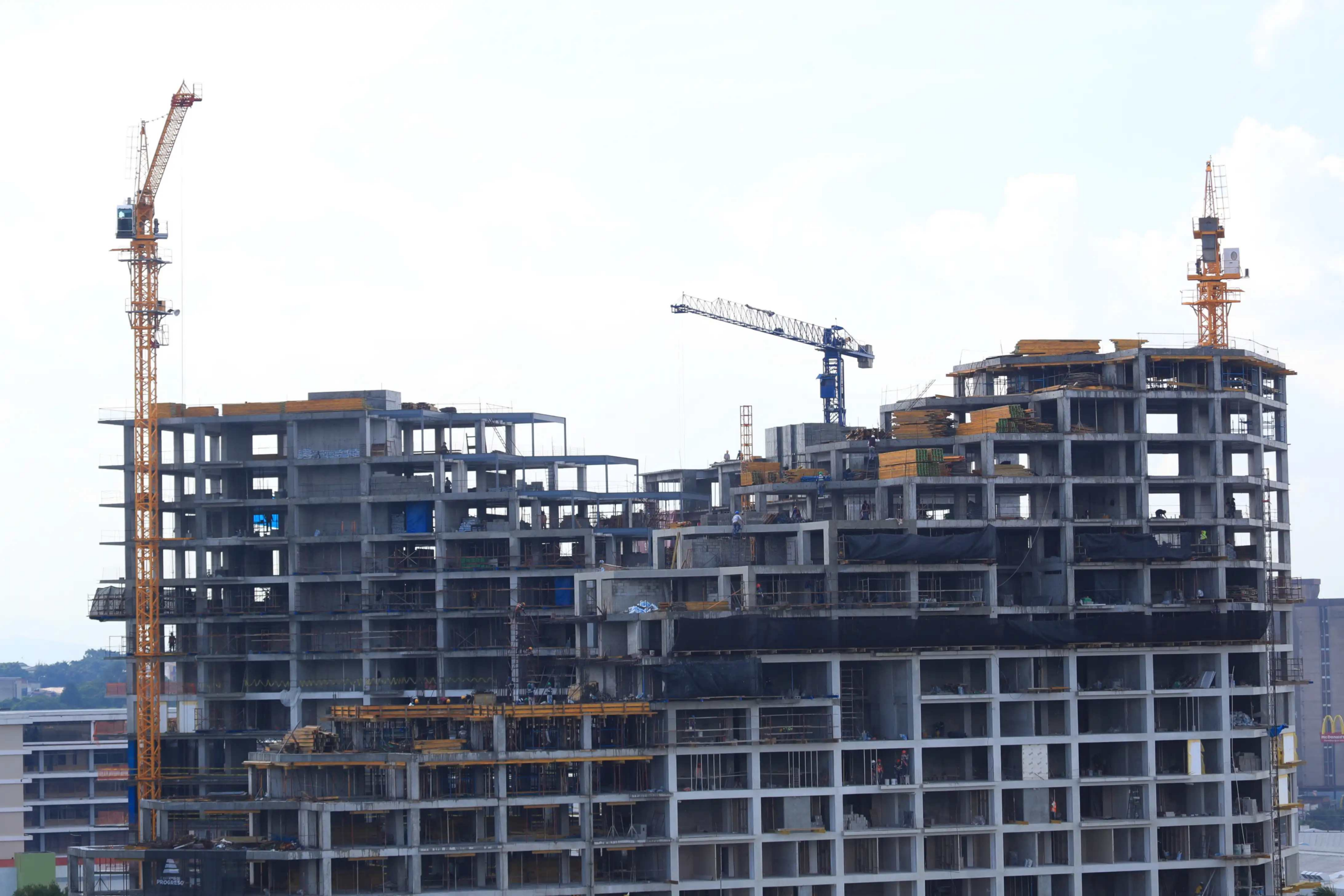
In Guatemala, buildings could reach up to 100 meters in height. However, after the repeal of resolution RES-DS-84-2020, which expanded the height limit, the General Directorate of Civil Aeronautics (DGAC) returned to the internationally approved limit.
The resolution approved in 2020 raised the maximum construction limit to 1,621 meters above sea level (masl), but after its elimination the parameter of 1,551 meters above sea level, established by international standards, was reestablished.
This measure was taken under the argument that said regulation had no technical basis. The DGAC established height limits for buildings located in areas near the La Aurora International Airport (AILA), especially in zone 11 of Guatemala City, as a preventive measure while an updated technical study is developed to support these regulations.
A technical panel determined that allowing taller structures could reduce visual maneuvering space for aircraft and affect pilot approach routes.
During the panel “Urban excavations: protection of neighboring properties and risk management”, organized by the Association of Real Estate Developers (ADIG) this Tuesday, April 21, the issue of the height of buildings in the capital was addressed.
According to Andrés García, member of the AGIES board of directors, height restrictions directly affect the need to build downwards. “We are forcing ourselves to make basements because we have a need to have a car; basically, what we are doing is going deeper and deeper into the earth because the need is to make basements,” he explained.
García pointed out that, in other countries, urban and regulatory conditions allow this dependence to be reduced. “Under certain conditions, basements do not count as part of the building square meter above ground,” he indicated.
He also mentioned that factors such as soil type influence construction decisions. “In Panama there is a lot of sand and a very shallow water table, so deep excavations are not usually done and the parking lots are above the zero level,” he explained.
“The problem here is that, if we make parking above the zero level, it subtracts, let’s say, the useful area of the project. It is an issue that begins to be anchored to many other factors,” he said.
Municipal regulations
Diego Rivera, general director of Construction Project Management (CPM), explained that the Territorial Planning Plan (POT) of the Municipality of Guatemala defines how much can be built based on the area of the land.
“Zones G3, G4 and G5 are those that are designed for tall buildings. Depending on the zone, it is allowed to build several times the area of the land; for example, in zone G5 it can be up to six times,” he indicated.
Rivera explained that, if incentives are applied, it can reach up to nine times the square meters of a piece of land. “If you have 1,000 square meters of land, you can generate 7,000; they are counted from the floor level up,” he commented.
Rivera explained that these square meters are counted from the floor level up, which influences design decisions. “That’s why developers prefer to build basements: when the building is elevated, profitable square meters are consumed,” he said.
He added that the municipality recently updated the regulations to allow certain parking spaces outside the street level not to be counted within the buildable area, which opens the possibility of moving them to higher levels.
Rivera compared the Guatemalan case to coastal cities like Miami, where soil conditions limit excavations. “In those cities you can’t build basements and the parking spaces go up,” he said.
However, he indicated that in Guatemala there is a restriction due to the proximity of the airport. “If we wanted to raise the entire building to street level, we also have the height limitation by Civil Aeronautics,” he explained.
He noted that these conditions are part of an interrelated system. “It is not just an entity; it is not just reaching the municipality and changing a rule, because there is also the Civil Aeronautics cap,” he stated.
García agreed that an alternative to reduce excavations would be to move part of the construction upwards. “If we don’t want to dig so deep, we have to remove the building, but that’s where another problem comes in: we can’t build that much. That’s an issue in this city,” he concluded.