
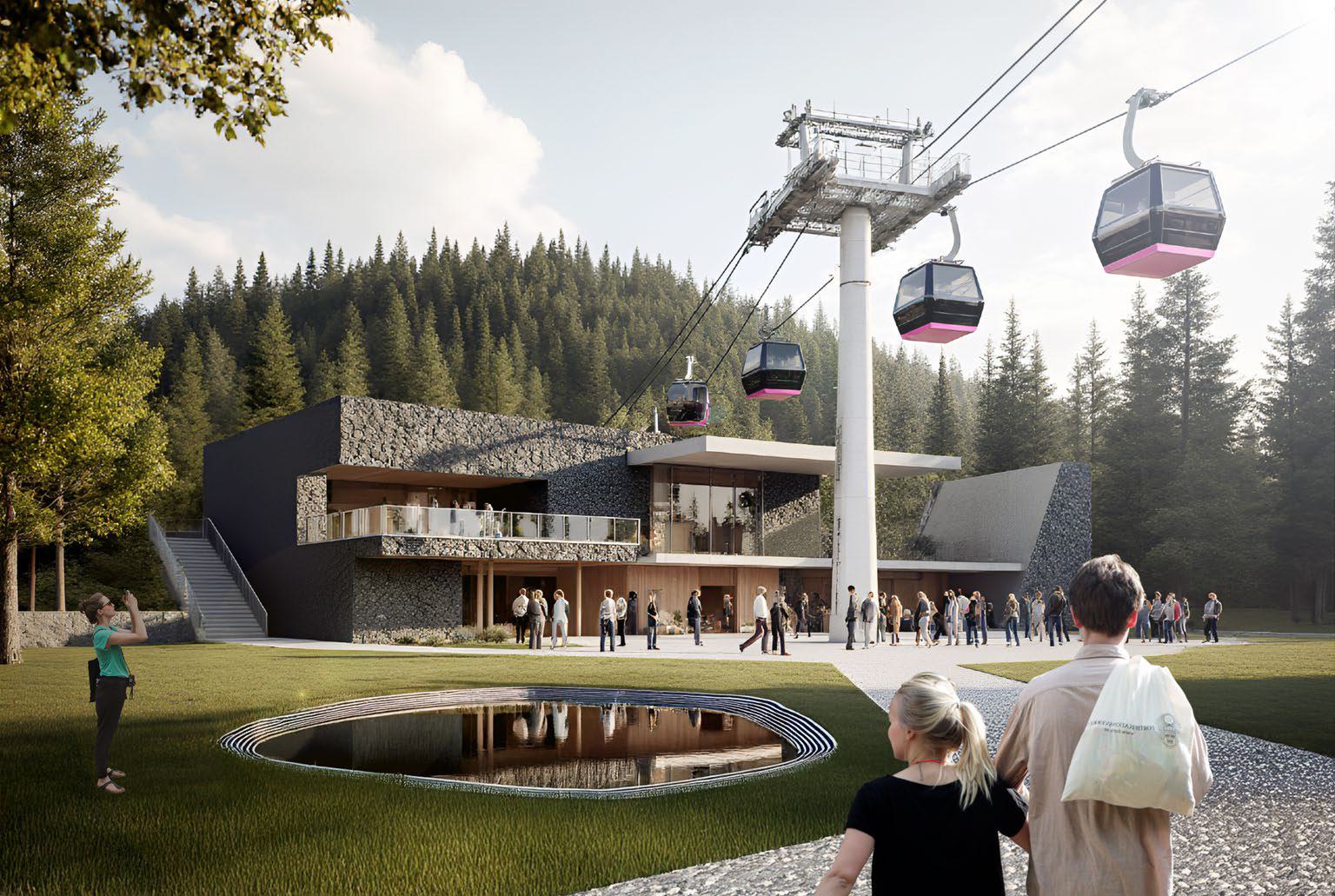
The municipality of Sololá, near Lake Atitlán, is planning the construction of a tourist cable car that would connect various emblematic points of the place, such as viewpoints and hotels.
The commune stipulates to execute the project under the public-private alliance modality, through the National Infrastructure Agency (ANI), the entity in charge of the works carried out through this mechanism.
The cable car would be built on the El Jaibal farm, property of the municipality, which has approximately five caballerías. In this place, the execution of a linear park, a hotel zone and a mini-hydroelectric plant are also proposed.
According to Guido García, electromechanical project manager at Doppelmayr, the company in charge of the construction of the Aerometer in Guatemala City, a cable car of this type is technically viable and can be adapted to these environments.
According to García, this type of system works with electrical energy, has low soil intervention and can be installed in complex geographies, valleys or areas near bodies of water. Financial viability, he added, depends on demand studies that define the flow of users and their behavior over time.
This is an excerpt from the conversation he had with Free press.
In Sololá, a tourist cable car is proposed in the Lake Atitlán area. From your experience, how viable is it to develop a project of this type?
It is an emblematic and beautiful place in Guatemala. The feasibility can be analyzed from two aspects: the technical one, which is perfectly possible, since it is an ecological transportation system that uses electrical energy for its operation and does not generate pollutants in the environment. In addition, it produces a low level of noise and has little intervention or impact on the ground to implement the system.
From a financial point of view, to determine if it is a good investment, a prior study must be carried out to define what the demand will be, that is, what public and what number of people will use it, either by season or at different periods of the year. Based on this, the type of cable car is defined, since there is a fairly wide variety: they can be continuous or reciprocating, with different capacities depending on demand.
What geographical or technical conditions make a place suitable for installing a tourist cable car?
Our experience shows that in regions such as the Swiss Alps, cable cars are used precisely to preserve the environment, both landscape and ecological. In such mountainous regions, the cable car is perfectly suited.
It has also been seen that it is not only used in irregular geographies, such as valleys or mountains, but that it can adapt to flat places without restrictions. There are examples such as the city of La Paz, where there is a cable car in the highlands that transports more than 3,000 passengers per hour, in each direction.
In general, the cable car adapts to different geographical conditions and can overcome obstacles such as rivers, valleys or mountains. Furthermore, the impact on the soil is minimal. Unlike a road, which requires extensive intervention, the cable car only needs specific castings of approximately 2.5 meters to install the towers that support the system.
What does a project need to be attractive to a cable car developer or investor?
As in any project, the cost-benefit is analyzed. On the one hand, there is the initial investment in the equipment and, on the other, the investment in long-term operation. These two must generate a profit for the project to be attractive.
If the cable car is part of a complex, such as a tourist complex with hotels or a linear park, it can facilitate access for users and generate greater occupancy. This increases demand, which is key so that investment and operation costs translate into a benefit for the project.
What studies are essential before building a cable car?
The main one is the environmental evaluation, which analyzes the impacts during the construction and operation of the project. Geological studies are also carried out to determine the type of soil, topographic studies to define the location of structures and climatic and seismological analyses, among others.
What role do local governments play in making these types of projects viable?
As in any municipal system, authorities must ensure the protection of the areas and understand how the system works. It is important that the project shows the beneficial effects it will have, such as job creation, tourist attraction and economic impact.
It is also necessary that there is adequate dissemination so that the authorities and the population understand the level of impact of the project, in order to avoid a perception that it could be contrary to nature. The effects of this type of system are minor compared to other means of transportation that could be offered in this complex.
What are the main differences between a tourist cable car and an urban one?
The system is basically the same. The difference is in the number of hours of operation and the number of passengers it transports. For example, an urban transportation system is designed to transport the maximum number of passengers at the highest possible speed from one point to another. In the case of a tourist system, it would not need speed, because it will possibly have a smaller number of passengers.
The more space there is, the more the landscape around the park can be enjoyed from a unique perspective from the cabin. This project is a tourist attraction; that’s the difference.
How long can the development of a cable car of this type take?
In fact, it’s pretty fast; However, it depends on the project and who is developing it. From the preliminary project to the final design and the start of construction, the process can vary. However, once construction begins, the system may be operational in about a year, depending on the size of the cable car and the environment.
The factors that could delay or accelerate the process are economic and administrative.
What does the cost of a cable car depend on?
The cost is directly related to the capacity of the system. There are cable cars with cabins for four or five passengers, up to systems with greater capacity. As capacity increases, so does cost.
In addition, the cable car itself can become an attraction, as it offers panoramic views and a different experience for users.
What type of maintenance does a cable car require?
It is not a complex system. In urban systems, maintenance is generally performed at night. In tourism systems, where there may be variations in demand, maintenance programs are established to guarantee operation during peak seasons.
The standards used are mainly European, since in many regions of America there is no specific regulation for this type of systems.