
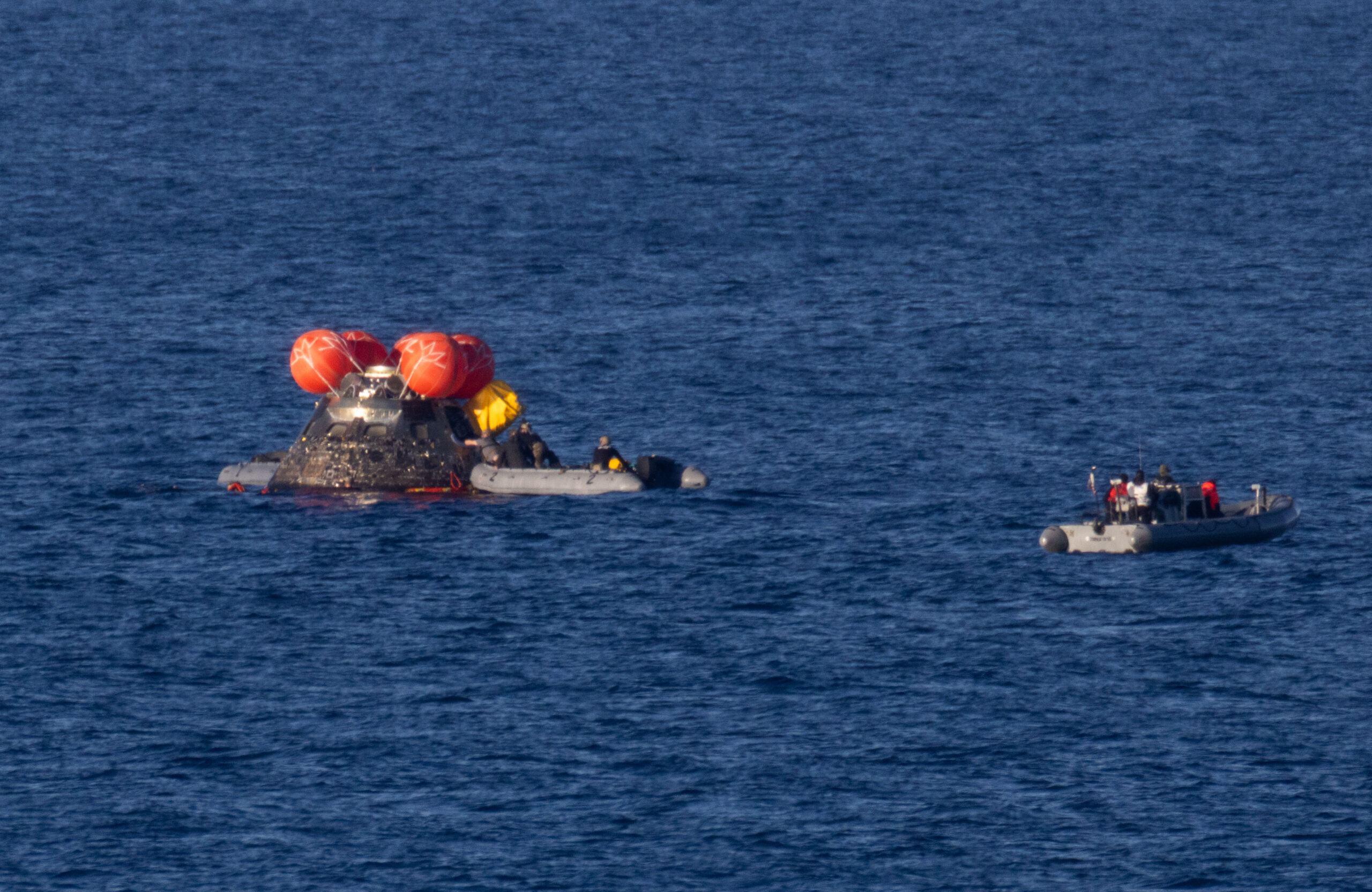
The Artemis mission II marked an important milestone for the United States, as it represents humanity’s return to the Moon after the Apollo mission in 1972. The splashdown, which occurred on April 10, was a moment of joy for the astronauts, who were returning from a 10-day trip through lunar orbit.
This moment kept the entire country and space travel lovers attentive to the transmission, which showed the extraction process of the four astronauts after their splashdown in the Pacific Ocean, a moment that Commander Reid Wiseman shared.
The splashdown occurred at 8:07 p.m. EDT with 47 seconds, local time (6:07 p.m. and 47 seconds in Guatemala), and marked a historic moment. However, more than an hour after arriving on Earth, the recovery team entered the Orion spacecraft to rescue astronauts Reid Wiseman, Victor Glover, Christina Koch and Jeremy Hansen.
Off the coast of San Diego, teams from the National Aeronautics and Space Administration (NASA) and the United States Fleet Forces Command (USFFC) approached the ship to begin the recovery process.
Amid applause and shouts of joy, the recovery team opened the capsule. Subsequently, one of those in charge of evaluation and recovery entered the ship, followed by three other elements.
When the second of those in charge of the recovery, who was carrying the camera, entered, the four astronauts were observed happy for their return home, while they began the primary evaluation process after their exit from the ship, from where they were transferred to the USS John P. Murtha.
Along with the message “Jesse, Steve, Laddy and Vlad… What a thrill to welcome you aboard the Integrity after a journey of almost 700 thousand miles!”, the commander of Artemis II shared the emotional moment.
Orion’s main parachute has deployed. The spacecraft has a system of 11 chutes that will slow it down from around 300 mph to 20 mph for splashdown.
Get more updates on the Artemis II blog: https://t.co/7gicm7DWBt pic.twitter.com/ReXHTfkFld
— NASA (@NASA) April 11, 2026
Likewise, he highlighted: “We will be eternally grateful to them for their service to our crew and the nation.”
In total, the astronauts traveled approximately 9 days, 1 hour, 32 minutes and 15 seconds, which took them into lunar orbit and exploring the far side of the Moon, where they were able to document the satellite area, as well as test the Orion systems.
It is known that NASA is already developing the Artemis III mission, which plans to explore the Moon again in 2027, as part of the process of returning to the natural satellite and establishing a permanent base.
Jesse, Steve, Laddy, and Vlad….such an incredible feeling to welcome you aboard Integrity after a nearly 700,000 mile journey. Forever grateful for your service to our crew and the nation. pic.twitter.com/lJzNPkBIpq
— Reid Wiseman (@astro_reid) April 14, 2026