
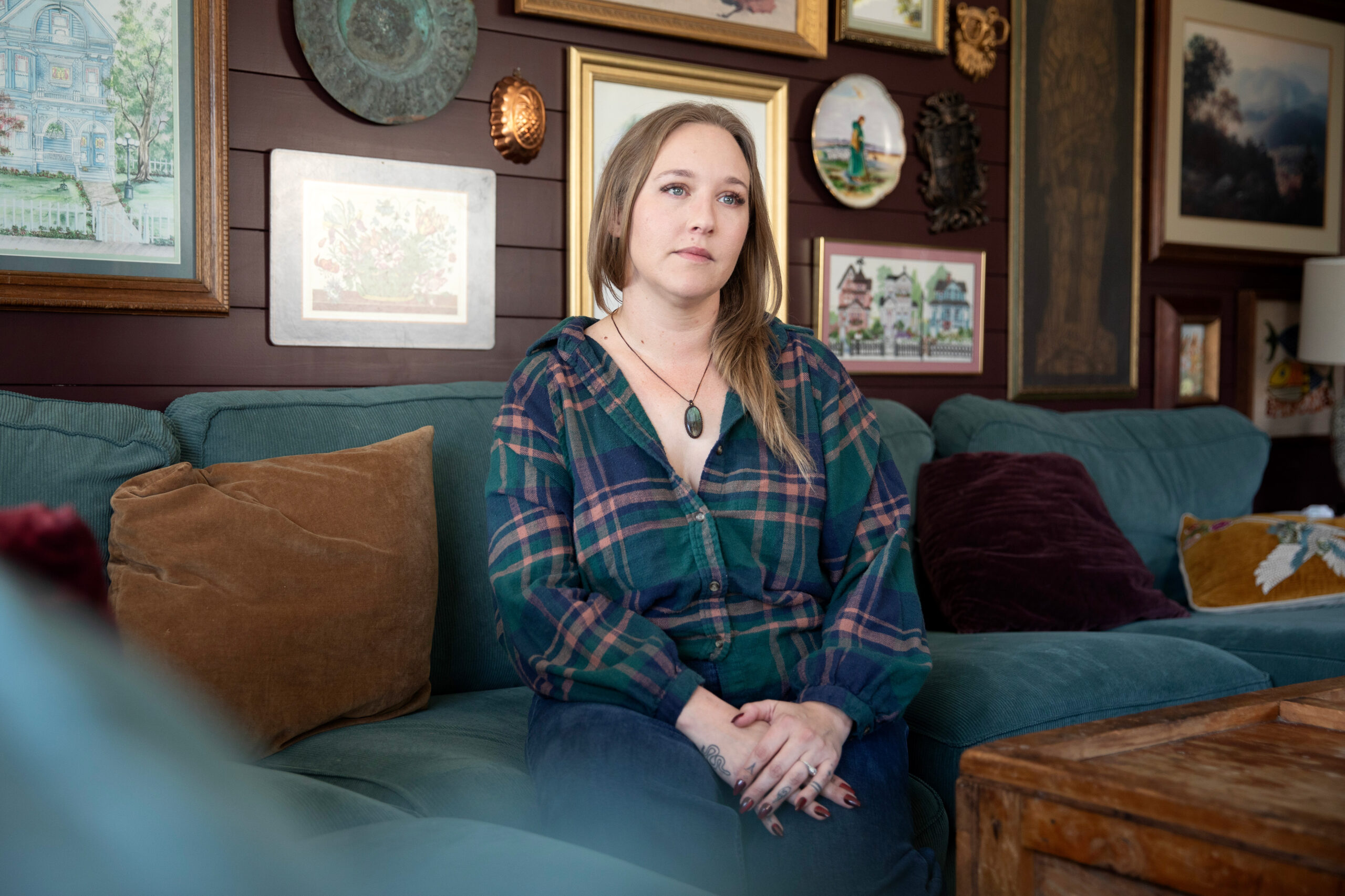
Katie Jennings was checking her phone last April when a headline chilled her. A second unvaccinated child had died of measles in his home state of Texas.
It was a turning point for the 40-year-old housewife who had grown up in a staunchly anti-vaccine fundamentalist Christian community. “What are we doing? Why are we doing this?” he remembers thinking. “I wanted to protect my children.” She took her six children to get vaccinated against measles, mumps and rubella. He then posted an emotional video on TikTok directed at the anti-vaccine group he was previously a part of: “You can change your mind,” he said in the video, which has been viewed more than 422,000 times.
Measles has spread in the United States, reaching levels of infection not seen in decades and threatening the eradication of the disease in the country. This year, the Centers for Disease Control and Prevention recorded 1,748 infections as of April 17, a figure that far exceeds last year’s figure, although public health experts say the national numbers are likely well below the total. For some vaccine-hesitant parentslike Jennings, pressured by Health and Human Services Secretary Robert F. Kennedy Jr., witnessing the outbreak ravaging their state has made the severity of the disease more palpable.
They are beginning to question their deepest beliefs and the conspiracy theories that fueled them. And in several measles hotspots, enough of them are quietly changing their minds about the MMR vaccine, which is helping to curb outbreaks. South Carolina’s health department saw a nearly 170% increase in measles, mumps and rubella (MMR) vaccinations at free clinics during January compared to the previous year, and is close to declaring an end to the outbreak. In Texas, MMR vaccinations increased 15% last year, before the state declared an end to the outbreak in August.
Utah’s health department has also seen an increase in vaccinations since last summer, a hopeful sign for the country’s most active current outbreak. Any change of opinion among anti-vaxxers is notable, given that this community came together largely around Kennedy, who has spread disinformation about vaccines in his Make America Healthy Again agenda. The growing number of MAHA supporters getting vaccinated as measles comes to town calls into question the strength and sustainability of their movement.
In recent weeks, Kennedy himself has remained silent on this highly controversial issue ahead of the midterm elections, following instructions from the Trump administration to focus on more far-reaching arguments. Stuart Simko, a pediatrician in Greer, South Carolina, a county that borders Spartanburg, the epicenter of the state’s outbreak, said he receives several calls a week from undecided parents. They usually start with something like, “Hey, I know I’ve always been against vaccines, but measles is around here. What do you think?” he said. Simko and her team try to build trust without pressure or judgment. “For some reason, they have different information,” he said. Analyzing what they have read and heard, and dispelling their particular concerns, is part of the process.
It is also essential to provide them with the assurance that their decision is deeply personal and private. “You don’t have to tell anyone that you gave your child any vaccines,” she said.
The decline in childhood vaccination rates accelerated during the Covid-19 pandemic, helping to create the conditions for the resurgence of measles. Some people simply skipped vaccinating their children because lockdowns disrupted routine visits to the pediatrician. But rates also declined as anti-vaccine activists, who spread distrust of science and misinformation linking the MMR (measles, mumps and rubella) vaccine to autism, convinced more parents to opt out of vaccinating their children.
Heather Simpson, 35, used to be one of those influencers. She became anti-vaccine after she began “absorbing misinformation” on the internet, including interviews with Kennedy. Later, she had difficulty getting doctors to diagnose her daughter’s sleep apnea, which reinforced her stance against the established medical system. Simpson, a Dallas resident, said his trust in the healthcare system had been “completely destroyed.” Her role as an influencer arose by chance in 2019, when she decided to share her opinions about vaccines in a Facebook group of like-minded mothers. Almost instantly, thousands of followers offered her a community, something she said was missing in her life.
In addition, her posts had a great impact, including one in which she appeared dressed as a measles for Halloween, which made national headlines.
However, his opinions began to diverge during the pandemic, when he found it difficult to oppose what cConsidered common sense measures to protect others, such as wearing masks. He also began to question the authority of anti-vaccine leaders on other health issues. When she began speaking openly online about her changing perspective in 2021, her support network fell apart.
“We lost real friends,” Simpson said. She suffered panic attacks, worried that maybe her old community was right about vaccines. The doctors, who patiently guided her through her concerns—rather than overwhelming her with data—helped her reaffirm her resolve to catch up on her daughter’s immunizations. Her experience led her to help create Back to the Vax, a small online support group for anti-vaccine people who are slowly unlearning what many of them have been told their entire lives. It is not a simple process.
For Jennings, it involved not only questioning the logic of skipping injections, but also confronting an entire worldview that previously governed all of his decisions. In their former religious community, members distrusted doctors and considered their pastor as the highest authority. Deconstructing those ideas publicly on TikTok helped her connect with people outside her circle. “It’s been cathartic for me and helped me process everything,” said Jennings, whose children have now received all the standard childhood vaccines, in addition to those for Covid-19 and the flu.
His vaccine-related TikTok videos often receive a lot of support from commenters who identify as healthcare workers. “You have done a very brave thing!” said one. Doctors on the front lines during measles outbreaks play an important role, educating a population that has no collective memory of the disease, said Paul Offit, director of the Vaccine Education Center at the Children’s Hospital of Philadelphia. When measles was eliminated in 2000, the fear of getting sick also disappeared. Lisa Carroll, a doctor in South Carolina and professor at Edward Via College of Osteopathic Medicine, participates in a weekly outreach program at a local food bank, where she increasingly finds families asking about the measles, mumps, and rubella (MMR) vaccine.
Hey, I know I’ve always been against vaccines, but measles is close by. What do you think?
Many of them are not explicitly anti-vaccines, they simply do not know the vaccine or where to get vaccinated, he explained. For some, it was easier to sign a waiver form. In these cases, information about the true risk and safety of the MMR vaccine has led to this change in mentality, Carroll said. For those who fear the vaccine more than the virus, simply telling them what to do does not work. Simko, who had never seen a case of measles before the outbreak that began in South Carolina in October, said it often explains the lesser-known but more common consequences of contracting the disease, such as immune amnesia.
The virus can cause the body to lose its natural immune response to other diseases and leave the person immunocompromised for years. This may be compelling to some people. Ultimately, hesitant parents have to do their own soul-searching, and that takes as long as it takes. Despite her strong pro-vaccine stance, it took Simpson years to vaccinate her now eight-year-old daughter against measles, mumps and rubella. Even when she saw measles circulating in her hometown of Lubbock last year, she hesitated because of her persistent anxiety. When the numbers in Texas began to decline, he stopped feeling that urgency.
But now, you see headlines announcing a gradual increase in infections in Utah and Florida. It’s time to get vaccinated against measles, mumps and rubella, he said. “I completely understand each and every fear behind it,” Simpson said. “I’m going to do it anyway, and that’s why it’s the best decision.”