
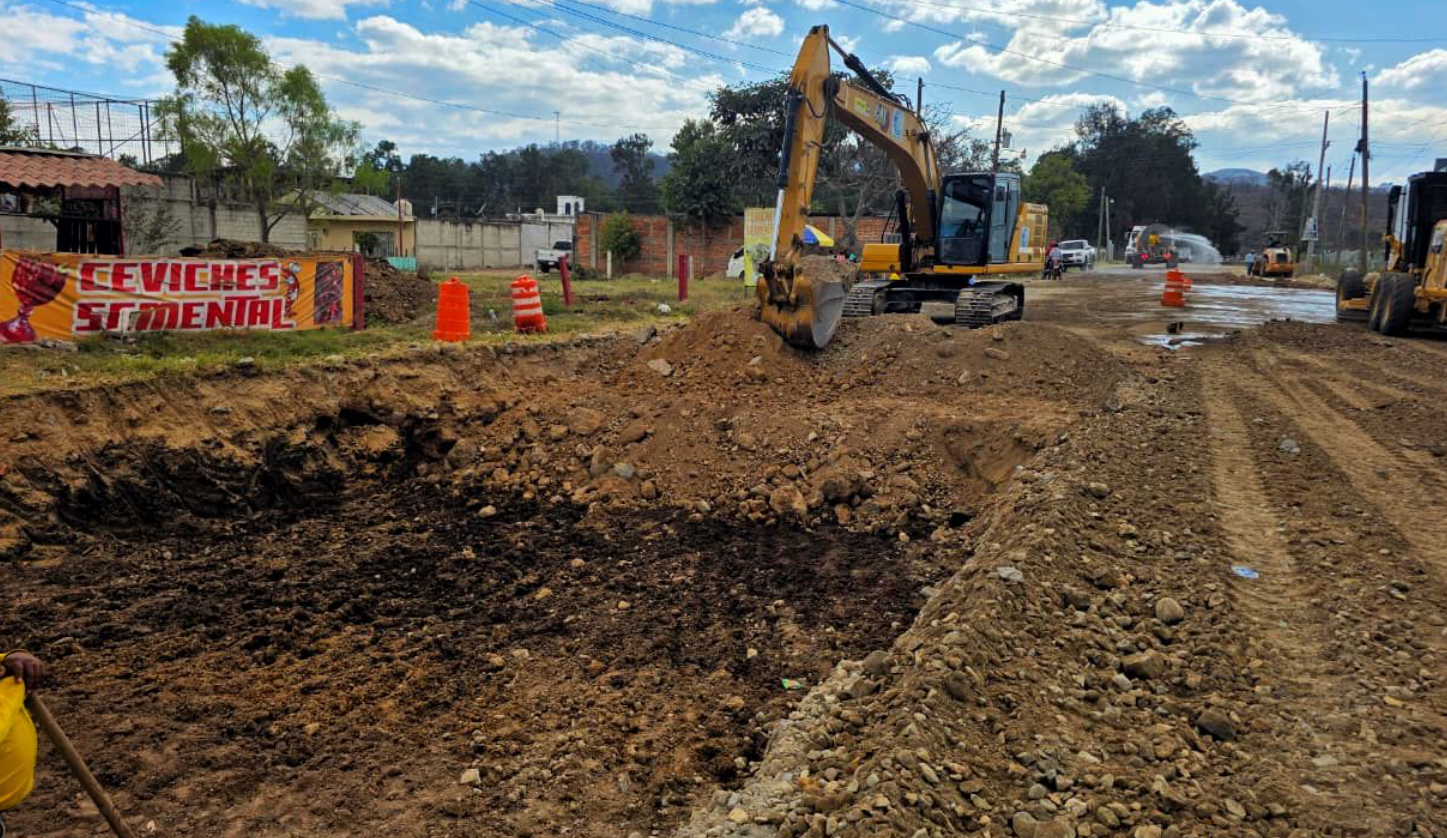
Last week, the Ministry of Communications, Infrastructure and Housing (CIV) announced progress in the Jalapa bypass, a work that seeks to alleviate traffic in this area. This is a project that has an approximate length of 11 kilometers of paved route that will allow it to surround the municipal seat of the department.
According to official information published by the Guatemalan News Agency (AGN), work is currently underway on the construction of a bridge within the route, which will be 40 meters long and 12 meters wide over the Jalapa River. At that point, works such as the upper curtain and the assembly of diaphragms are carried out, key elements for the resistance and durability of the structure.
In addition, at the entrance to the project, a third lane is enabled for those traveling from Monjas to Jalapa, so that they can continue their journey without entering the new section. Mixing work on the base layer and primer is also carried out, with the aim of improving the durability of the pavement in the face of the constant passage of vehicles.
The bypass will have a section 9.6 meters wide, distributed in two lanes. Likewise, the construction of ditches on both sides of the road is contemplated to guarantee adequate drainage, in accordance with technical specifications aimed at road safety.
According to Delfino Mendoza, a member of the Guatemala No Se Detiene infrastructure table, this work was announced in August 2022 by former president Alejandro Giammattei. Subsequently, in May 2023, it was awarded to the company Consultores Civiles, SA for Q121.8 million and contemplated an execution period of 12 months.
According to information from the Secretariat of Planning and Programming of the Presidency, through the National Public Investment System (SNIP), Q38.1 million were executed in 2024; in 2025, Q36.7 million, while in the current year Q757 thousand are reported.
In 2023, 4.87% of a physical goal of 0.39 kilometers was achieved; In 2024, 90% of a physical goal of 3.07 kilometers was executed, while 2025 closed with an execution of 89% of a physical goal of 4.19%. So far this year, an execution of 68.25% of a physical goal of 0.14% is reported.
At the beginning of 2025, a 12-month extension was authorized. “They are not going to come out within that extension, but at least the project is already moving forward. It is three years behind schedule, it should already be finished. I hope they do not suspend it and give it continuity so that it can be completed,” he said.
He added that, although the State Contracting Law (LCE) allows these extensions to be made, many of these are linked to an increase in cost, which further complicates the execution of the work. When they are related to deadlines, the process is simpler. “Although it is not ideal when the project is 60% complete, it is best to find a way out and not let it be abandoned,” he mentioned.
When could it be ready
Mendoza pointed out that the project could be completed in a period of between six and eight months, as long as the legal and financial conditions are met. “If they could be finishing it in six or eight months, the important thing is to find a technical and legal way to carry out the expansion, guarantee the flow of funds and accompany it with strict supervision,” he explained.
He indicated that, within that period, the construction company must maintain an adequate pace of work and even expand the fronts if necessary to meet the established time.
He added that progress will depend on the commitment of both the company and the CIV. “If there is a commitment from the company to work at an accelerated pace and from the Ministry to maintain the flow of funds, the project can advance,” he said.
He explained that one of the main problems in this type of works is the delay in payments. “Many times companies have the intention of working and finishing, but if they are not paid, they begin to slow down and there is a risk of paralyzing the project,” he indicated.
Given this, he stated that it is necessary to keep payments up to date to be able to demand compliance. “The Ministry must keep their payments up to date to also have a way to demand them,” he said.
The reason for the delay
According to Mendoza, the reason for the delay is that, during the previous administration, in the last year of its term (2023), many projects were contracted. “The historical trend in the CIV has been to contract about Q3,000 to Q4,000 million in projects per year and, in 2023, the last administration contracted a little more than Q10,000 million,” he mentioned.
He recalled that the budget managed in previous administrations was smaller for the CIV. “Their idea was to leave the projects tied up, so that the companies already had them contracted, regardless of the fact that they did not make much progress in the remainder of their period,” he said.
He added that the available budget was not sufficient to cover that volume of contracts. “The budget that was managed was smaller, so it was not enough for them to meet the payments that these contracts required,” he explained.
According to Mendoza, this situation caused several companies to stop the works. “The companies paralyzed due to lack of payment,” he stated.
He indicated that, with the change of administration, the paralyzed projects were reviewed again. “When the new administration comes and sees all those projects stopped, they start reviewing them one by one,” he said.
He added that changes in authorities within the Ministry also influenced decision times. “With the changes in authorities, progress was made in some projects, but when someone new arrived they started the review again, and that delayed decision-making about their continuity,” he concluded.
It will alleviate traffic
Mendoza highlighted that the project will allow the diversion of traffic that currently crosses the center of the city of Jalapa, including heavy transportation. “Currently, vehicles going from El Progreso to Jalapa or looking for Jutiapa practically pass through the center of the city, and that greatly complicates traffic, especially heavy transportation,” he explained.
He pointed out that the bypass will allow this vehicular flow to be transferred to an alternate route. “With this type of works, the aim is to remove traffic from the city center and pass it on one side, which is the trend,” he indicated.
He added that this practice is not exclusive to Jalapa. “It doesn’t just happen in Jalapa, in many cities it is already difficult to cross the center of towns, even in places that are not departmental capitals,” he stated.
Mendoza indicated that, due to the volume of traffic in a departmental capital, the impact of this type of projects is greater. “In a departmental capital, traffic is higher, so it is a project that can have a lot of benefit,” he noted.
He also highlighted the impact on product mobility. “The mobility of people and products is basic. Jalapa, due to its climate, has important production for the basic basket, and being able to transport these products to markets like Jutiapa allows for greater agility,” he explained.
Likewise, he pointed out that road projects have effects on the economy. “All highway projects have an important impact because they generate employment during construction and then boost economic activity when they come into operation,” he indicated.
It is estimated that the complete route could be completed in approximately 12 minutes and 30 seconds, at a speed of 60 kilometers per hour. The project will directly benefit more than 65 thousand people from nearby communities.