
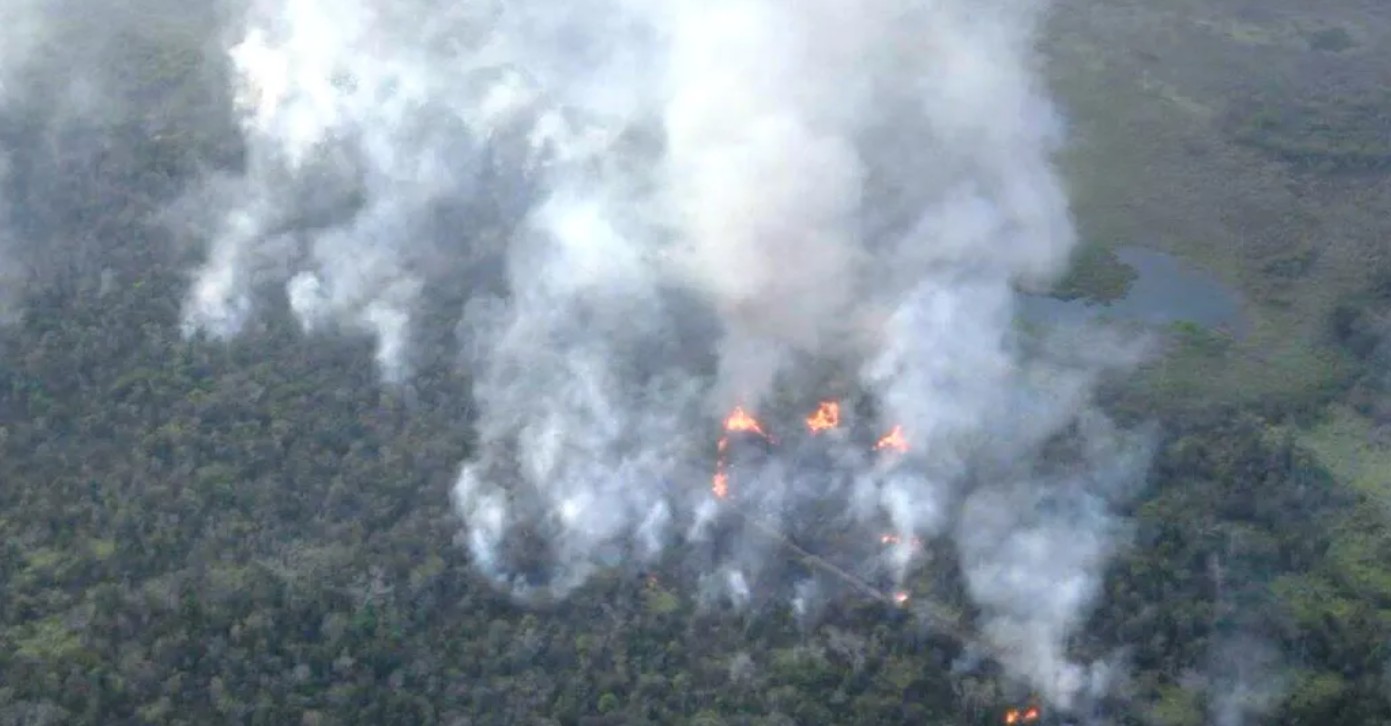
Of the 3.6 million hectares of forest in the country, Petén concentrates 1.6 million —45%—. To better size that extension of land: it is eight times the department of Guatemala covered with trees and vegetation.
But every year that natural wealth is threatened by fires. Between 2020 and 2025, the flames damaged 111,512.4 hectares of the Peten forest cover, according to a historical report from the National Forest Institute (INAB). This impact is equivalent to 2.4 times the department of Sacatepéquez or more than half of the department of Guatemala.
Rolando Vinicio Rodríguez Sosa, head of the INAB Forest Protection Department, points out that invasions, illicit logging to create clandestine trails and pastures and the use of land for crops represent a risk in the forested area, since to clear the land people use fire, which with carelessness can set the forests on fire.
Add that nine out of every 10 accidents recorded in the country are causedwhether intentionally or accidentally. In the latter case, it involves uncontrolled agricultural burning or garbage burning, which is common in rural areas as there is no adequate waste management. Thus, what begins as a bonfire spreads and becomes a forest fire.
Fire behavior
According to Rodríguez Sosa, every year the fire season In the national territory it usually begins in the department of Guatemala, mainly because people use fire in areas full of weeds as a cleaning mechanism and start construction, as well as to eliminate clandestine garbage dumps or pests, such as rats.
“The problem is that these fires become uncontrolled fires outside of forest cover; but at some point they can reach the forest or affect a structure, such as a home,” he says.
With each season the behavior of the fires has been identified: what starts in the capital Then it extends to the southeast of the country, where the finer and drier fuels are, such as grasslands, which due to the lack of rain are more susceptible to burning.
Then the phenomenon spreads to central highlands and heads west, until reaching the northern part, where the Verapaces and Peten.
This behavior can be observed with the fire report of the National Coordinator for Disaster Reduction (Conred) for the 2026 season. 878 fires registered from January 1 to April 6, the department of Guatemala is the most affected, with 143 accidents.
For now, Petén does not have major damage, since the ground is still damp. However, Rodríguez Sosa explains that, as April and May pass, the conditions will be different, and it is in June when the Peten forest is usually more vulnerable to accidents. In a matter of weeks, the department tops the list of those most affected by the fire.
Read also: Fires in Petén endanger protected species such as the jaguar and the scarlet macaw
Damage to ecosystems
Until April 6, the INAB counted 6 thousand 824.9 hectares damagedand the most affected departments are Baja Verapaz, Jutiapa, Jalapa and Quiché, which accumulate 3 thousand 899.7 hectares, which represents 57% of the total reported. While Petén, in the same period, had 43 hectares affected by the fire.
As the heat increases in the country, forest fires will be more recurrent in the country. petenera jungleand the threat to biodiversity It is a consequence whose recovery can take decades.
Rodríguez Sosa indicates that several factors influence the process, such as the type of ecosystem affected and the severity of the damage.
He adds that in Guatemala there are around six types of ecosystems. Some are dependent on fire, like the one found in the central highlands. This means that the fire affects them and they are the ones that burn the most; However, after a short time, when the rains fall, they recover, because the species present there have adapted to these conditions.
But the same does not happen with the ecosystem mangrove swampwhich is highly susceptible to fire, so the damage is more severe and the recovery time is longer.
The recovery These spaces will also depend on whether it is assisted or natural. In the first there is human intervention; In the second it depends on nature itself.
According to the National Council of Protected Areas (Conap), fires affect the wildlife. The first to suffer are the chicks or young birds that nest in treesnot having the ability to fly to escape. Amphibians and reptiles also suffer, as they cannot move at the same speed as the flames.
In Petén there are emblematic animals such as the jaguarthe tapir and the scarlet macawwhose population is small; However, there are other species that die or lose their habitat—nest, food, and shelter—as a result of fire.
It is difficult to determine how many animal species are harmed in an incident, since, according to Conap, the flames leave no trace.
The fire season 2024 has been the most damaging to biodiversity in Petén. The INAB registry indicates that that year they were affected 49 thousand 279 hectares. Closely followed by the 2020when they were damaged 48 thousand 772.