
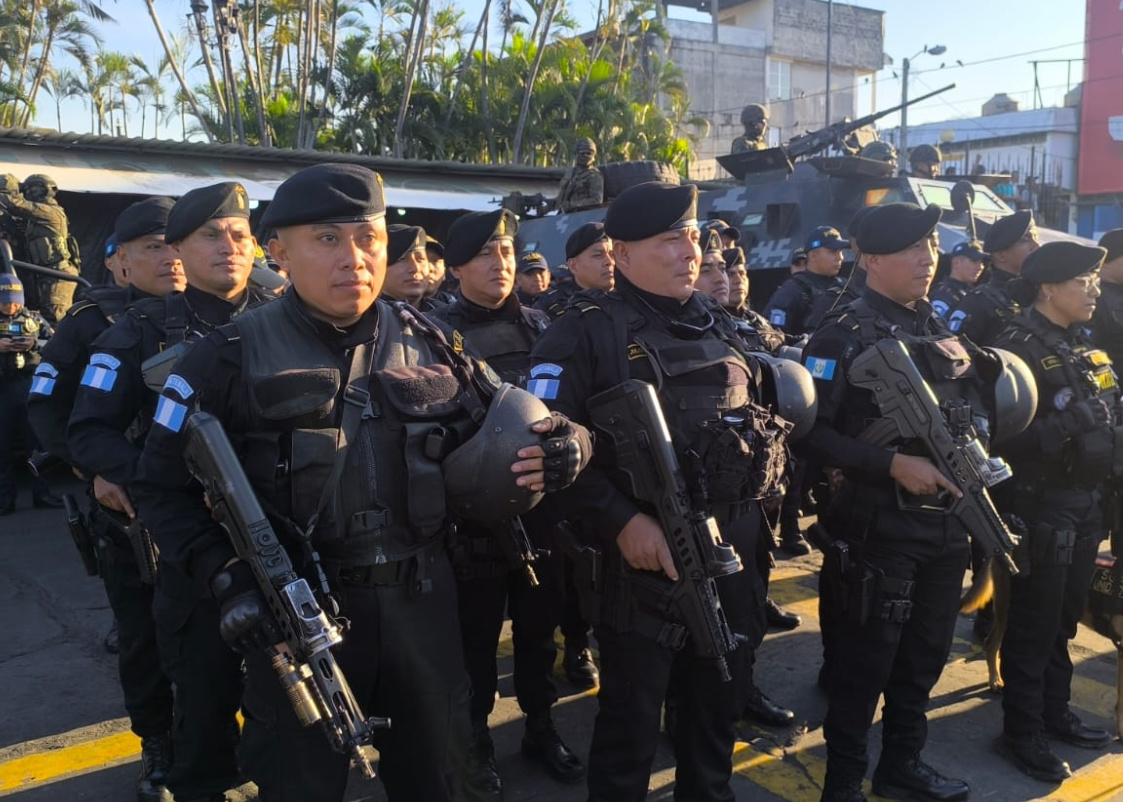
Guatemala reports a rate of 16.8 homicides per 100 thousand inhabitants until March 2026, according to data presented by the Minister of the Interior, Marco Antonio Villeda, this Wednesday at the discussion “Security and development in Guatemala: strengthening coexistence for a prosperous future”, organized by Fundesa, which is part of the first events of the National Meeting of Entrepreneurs (ENADE) 2026.
The Fundesa Coalition for Citizen Security proposed reducing homicides by half in the next ten years, that is, going from 16 to eight per 100 thousand inhabitants. According to data from the International Monetary Fund, violence costs Guatemala up to 7% of the Gross Domestic Product (GDP).
According to Juan Mini, president of the ENADE 2026 organizing committee, security not only affects the development of the country, but also thousands of Guatemalan families. “Strengthening security is necessary for a prosperous future. Without security, there is no investment, there is no employment or well-being,” he stated.
He added that in 2024, the year in which the last ENADE focused on security was carried out, Guatemala had a rate of 31 homicides per 100 thousand inhabitants. At that time, the country was ranked among the most dangerous in Latin America and the world. “Now we are among the moderately dangerous countries,” he commented.
He reiterated that during the last five years the country has not managed to reduce the rate of 16 homicides. “We are stagnant and sometimes the figure is rising. To become a truly safe country, which is the dream of all Guatemalans, there is still much to do to reduce homicides, extortion, gangs and drug trafficking,” he said.
In this context, Minister Villeda explained that the most significant increase began in 2000, until reaching its highest point in 2010. “It was the most violent year in our country, where we had 46.5 deaths per 100 thousand inhabitants,” he noted.
Starting in 2011, the trend began to decrease, reaching its lowest point in 2020, during the pandemic. “It was the least violent year in the history of our country, with an average of 15 deaths per 100,000 inhabitants,” he stated.
Subsequently, the rate increased to 16.6 in 2021. “In 2025, when I took office, we were at an average of 17.4 deaths per 100 thousand inhabitants,” he indicated. He added that, after the implementation of states of siege, states of prevention and other strategies since November, the rate stands at 16.4 homicides per 100 thousand inhabitants.
Prison system failures
Minister Villeda pointed out that homicidal violence in Guatemala responds to multiple factors. “We have violence caused by drug trafficking, gangs, common crime, personal revenge, among others,” he explained.
He added that there is a territorial concentration of the phenomenon. “70% of homicidal violence occurs in two departments: Guatemala and Escuintla,” he indicated. Likewise, he pointed out that 70% of extortions originate in prisons.
Villeda indicated that one of the main structural problems is found in the prison system, due to overpopulation and limited control capacity. “We have 25 penitentiary centers with capacity for 7 thousand prisoners, but currently there are almost 24 thousand, according to the biometric census that ended in January,” he explained.
This represents, according to the official, an overpopulation of 340%.
Added to this situation is the lack of personnel. “We have 4,000 prison guards in total, that is, 2,000 per shift to control 24,000 prisoners,” he said.
He indicated that salary conditions also affect the functioning of the system. “It is a very poorly paid prison guard, with salaries of around Q4 thousand a month, which makes them susceptible to being corrupted by criminals,” he stated.
Proposals
According to Mini, to reduce the homicide rate in the country, an agreed and consensual strategy is required in the coming months among the different actors involved. “Security is not a luxury, it is an indispensable condition for economic progress and social well-being,” he mentioned.
He added that achieving this goal involves transforming justice institutions. “We must achieve efficiency, responsibility, technology, favorable regulations, favorable laws, trained personnel, investment and citizen awareness,” he explained.
Likewise, he reiterated that the penitentiary system must be reformed and expanded with new maximum security prisons. “The largest amount of extortion in the country originates from there, many crimes are organized and sometimes the most dangerous prisoners escape,” he commented.
He also raised the need for greater institutional coordination. He pointed out that the Ministry of the Interior must work hand in hand with the Ministry of National Defense, the Judicial Branch (OJ) and the Public Ministry (MP) to strengthen criminal prosecution. In addition, he asked the Government for efficiency and transparency in the use of resources.
For his part, Minister Villeda agreed on the need for broader coordination within the security system. “The Ministry of the Interior is only part of the country’s security system. It is only one of the legs of the table. The other bodies must also fulfill their functions,” he stated.
He also pointed out the need to improve coordination between institutions. “The natural partner of the Minister of the Interior is the attorney general. There must be constant communication to request search and arrest warrants, and to operationalize actions against criminal phenomena,” he explained.
In that sense, he stressed the importance of the role of the MP and the judicial system. “We need a Public Ministry that investigates and an independent judicial system, with judges that issue the corresponding resolutions and that do not allow criminals to be released in less than 24 hours,” he indicated.
He added that new projects, such as the penitentiary centers in Izabal and Masagua, Escuintla, seek to implement a different model. “We cannot build new prisons to be managed by the same guard that has been involved in acts of corruption,” he said.
The minister also indicated that they are seeking to expand security personnel. “We need to increase the number of prison guards and renew the guard, which is currently susceptible to acts of corruption and not respecting protocols,” he said.
In police matters, he reported that three thousand agents have graduated and that another three thousand are expected to be incorporated in July, in addition to starting a new recruitment process. “The idea is that by the end of the Government, 12,000 new agents will have joined,” he explained.
Likewise, it announced the acquisition of equipment to improve operations. “We are going to acquire a thousand patrol cars and a thousand motorcycles. The last patrol cars were purchased in 2019, and if we do not do it this year we will enter a severe mobility crisis,” he mentioned.