
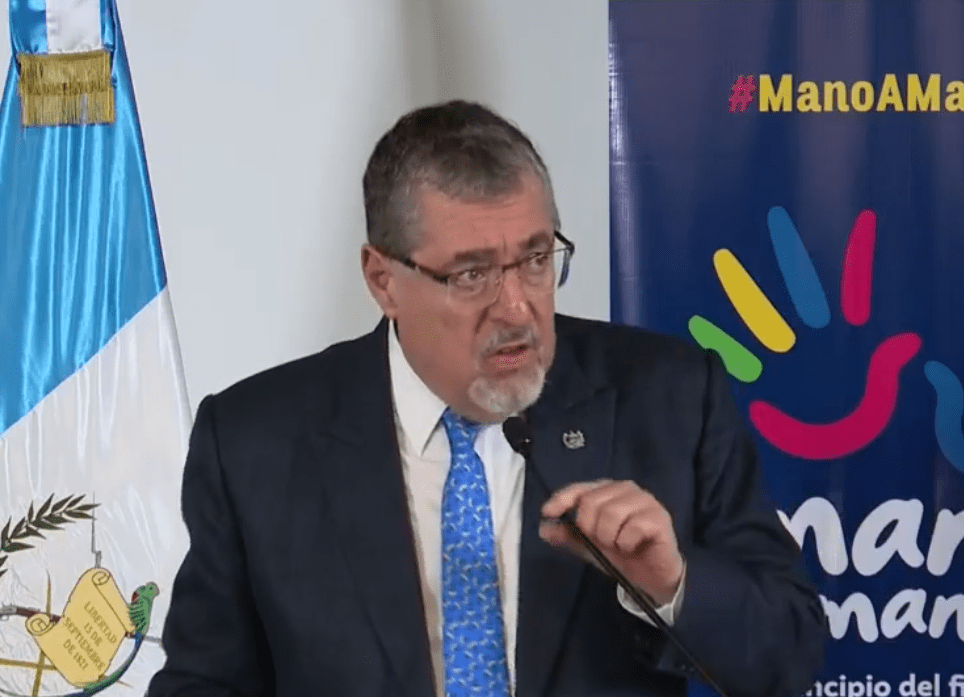
President Bernardo Arévalo, this Monday, June 23, at the press conference known as La Ronda, shared the Executive’s position regarding municipal autonomy and its scope on energy projects that have authorizations and are withheld or delayed.
He was also consulted about what actions the Executive will take to guarantee legal certainty and prevent this autonomy from becoming an obstacle for strategic projects.
Arévalo responded that municipal autonomy is a constitutional norm and explained what the limits are for State institutions to intervene, which is why the Government of the Republic “cannot intervene directly before a municipal government on these issues.”
He said that they consider it inconceivable that municipal governments begin to develop attitudes of opposition to projects that are necessary for the development of the country.
He recalled the recent situation with the private project Xochi, Corredor de las Flores, for which there was finally an agreement with the commune of Mazatenango that allowed its continuity.
“We call on all municipal authorities in the country to abandon any type of attitude that is contrary to this process of harmonization and joint collaboration for development,” he stressed.
He indicated that, depending on the case and at the time, consultations will have to be made, for example, to the Constitutional Court to determine to what extent an autonomy is exercised in a negative way and what is appropriate.
“In any case, we do not believe that this—municipal autonomy—puts the country’s risk rating at risk. We are moving forward; the risk rating agencies have increasingly confirmed the progress. We have one of the countries with the highest economic growth indicators in the hemisphere, in a context of recession and war worldwide,” the president highlighted.
On June 19, Free press reported that More than 41 projects, between transmission and energy generation, face difficulties due to decisions that the associations of that sector describe as arbitrary or discretionary by municipal authorities.
In interview with Free press, Carlos Arias, president of the Coordinating Committee of Agricultural, Commercial, Industrial and Financial Associations (Cacif), He explained that this situation discourages investment and asked the authorities to investigate cases of municipal arbitrariness due to charges and decisions related to projects of different kinds.
According to the interviewee, the lack of legal certainty, derived from municipal decisions that impose requirements or charges without legal basis, generates distortions in investment conditions.
Stay up to date with the Now newsletter. Key information at the moment it happens. Subscribe here.