
The Executive Agency reports progress in the simplification and digitalization of procedures as part of the efforts to strengthen efficiency in serving citizens. According to the Presidential Commission on Open and Electronic Government (GAE), currently 30 Institutions have services and procedures available by electronic means, which allows the population to carry out various procedures digitally.
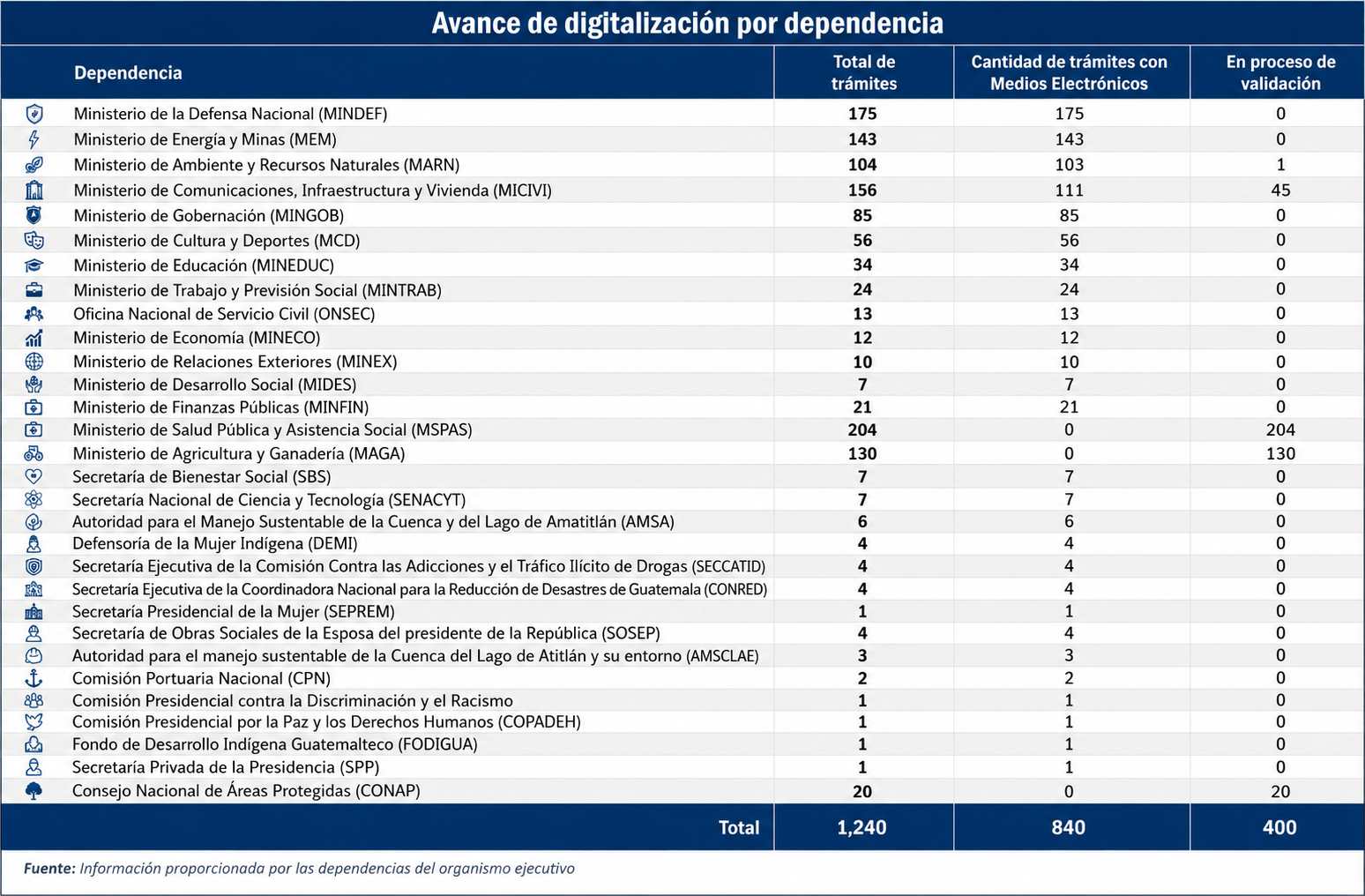
Of a total of 1,240 procedures identified by the GAE in the institutions of the Executive Body, 840 are already available on electronic platforms, while others 400 They continue in the validation process for their next incorporation.
Among the institutions that have the most digital procedures are the Ministry of National Defense (Mindef), the Ministry of Energy and Mines (MEM), the Ministry of the Interior (Mingob), the Ministry of Culture and Sports (MCD) and the Ministry of Education (Mineduc), which have managed to enable the 100% of your procedures in digital format.
In contrast, the Ministry of Public Health and Social Assistance (MSPAS) registers 204 identified procedures, none of them available by electronic means. They are followed by the Ministry of Agriculture, Livestock and Food (MAGA), with 130 procedures still in physical format, and the National Council of Protected Areas (Conap), with 20. According to the GAE, the procedures of these institutions remain in the validation phase before their incorporation into digital platforms.
Sigfrido Lee, analyst at the National Economic Research Center (CIEN), recognized the progress made by different institutions, although he pointed out that the digital transformation must be implemented systematically and comprehensively. “It cannot be that one entity advances a lot and then the one next to it does not advance enough,” he commented.
He explained that many procedures depend on coordinated processes between several institutions, so digitization only generates benefits when all entities involved reduce times and simplify procedures. “It is of no use to me to get the RTU in the SAT, if it then takes me six to 12 months to obtain the health license. In any case, it took me a long time,” he indicated.
He added that the greatest delay continues to be concentrated in institutions such as the Ministry of Public Health and Social Assistance and the Ministry of Environment and Natural Resources, where there are still procedures with long response times.
For her part, Claudia Del Águila, Director of Advocacy for the Export Environment at Agexport, stated that the digitalization of public services represents progress towards a more modern and efficient State, although she considered that the success of the process will depend on whether the changes truly simplify management for citizens and companies.
“The true measure of success is not only how many procedures are digitized, but whether this digitization really simplifies management for citizens and companies. In many cases there are still hybrid processes, duplication of requirements, manual validations or response times that limit the expected benefits,” he noted.
Procedures in government institutions
Reduction of procedures
Lee considers that one of the main challenges is to ensure that digitalization transcends the conversion of physical forms to electronic platforms and translates into integrated processes between public institutions.
He explained that, when a State entity already has certain information about a citizen, it should not be requested again in another procedure. As an example, he mentioned the Unified Tax Registry (RTU) and indicated that, if a government agency already has that document, it would not make sense to demand a copy from the user again.
In his opinion, this progress requires consolidating a digital identity that allows information to be shared between different state entities and avoids duplication of requirements. “Much of this information should already be systematized around what is known as digital identity. Guatemala already has the technology and the institutions, but it does not really implement it,” he commented.
Likewise, he pointed out that another challenge is to prevent processes from being only partially digital. He explained that, in some cases, users carry out the process online, but later the process once again depends on manual processes or printed documents.
As an example, he recalled the process related to the proof of vehicle circulation tax. Although payment could now be made electronically, it was still necessary to present the printed document during transit checks. “The process was not digital, it was still manual,” he said.
For his part, Del Águila indicated that digital transformation must be accompanied by administrative simplification, interoperability between institutions and the elimination of unnecessary requirements. “The user should be able to carry out a procedure from start to finish online, with traceability and certainty about response times,” he said.
He added that, from the experience of the export sector, when digital processes are correctly designed they allow reducing costs, strengthening transparency and reducing spaces for discretion.
Digitalization is not yet perceived
Although he recognizes the progress achieved by different institutions, Lee considered that these are still not widely perceived by the population because the process has not been implemented in a comprehensive manner. “Unfortunately we are always going to measure the State by its worst procedure,” he commented.
He indicated that, although some entities have modernized their services, citizens continue to face in-person procedures or long response times in other agencies, which reduces the perception of improvement.
He added that there is also a disconnect between the digital transformation strategy and users. “We really don’t know what the State’s digital transformation policy is and the population does not feel part of that policy,” he said.
In his opinion, in addition to promoting technological changes, it is also necessary to communicate to citizens how these tools are being implemented and how they can use them.
In that sense, Del Águila stated that the perception of change will depend on whether digitalization effectively simplifies user management. “For citizens to perceive the change, it is essential that digitalization be accompanied by administrative simplification, interoperability between institutions and more effective communication about the available services,” he indicated.