
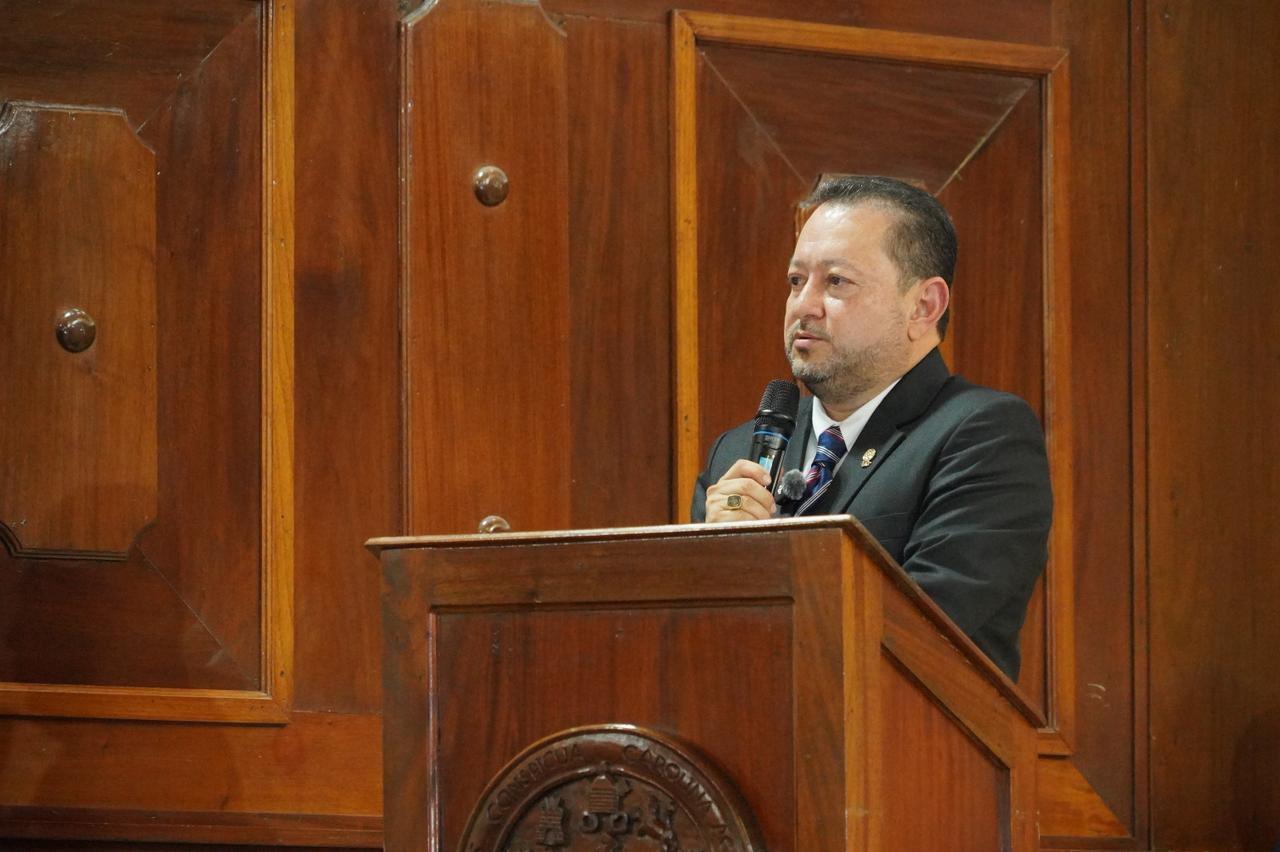
After learning how the legal team of the University of San Carlos (Usac) justified the permanence of Walter Mazariegos in the rectory Without presenting the settlement from the Comptroller General of Accounts (CGC), analysts believed that the Probity Law, enacted in 2002, should prevail over the Organic Law of the USAC, in force since 1947.
Mazariegos assumed his second term as USAC rector on July 1 and in the first session of the Higher University Council (CSU), the legal opinion was presented with which it is maintained that the settlement is not required for the position.
The principle of legal specialty that the Usac lawyers used to prevent Mazariegos from presenting the settlement, consists of applying, for a given matter, the most specialized law – the Organic Law of the Usac – which, according to that criterion, prevails over the Probity Law.
This principle is regulated in article 13 of the Law of the Judicial Branch, which establishes: “The special provisions of the laws prevail over the general provisions.” This interpretation is applied when there are laws that conflict because they are applicable to the same issue.
However, the argument of the USAC legal team lacks support, indicated Javier Monterroso, doctor in Constitutional Law. He added that, because the Organic Law of the USAC dates back to 1947—promulgated during the government of Juan José Arévalo Bermejo—, this case must be analyzed according to the chronological criterion, according to which the rule issued later must be applied, since the legal system evolves over time.
“The criterion they are using is not appropriate, firstly because the principle of specialty refers to a specific situation to see which law applies, the general or the specific.
But in the chronological criterion, the law that was approved later is the Probity law, which is from the nineties; So, when this law is approved, it says: it applies to all State institutions, not just the central government,” said Monterroso.
Mazariegos does not have a settlement because the Comptroller’s Office filed three complaints against the members of the CSU of the Usac, which he presides, for omitting calls to elect representatives of academic units, approve hiring without adhering to the internal regulations of the university and make decisions with members whose terms have already expired.
The Constitution must prevail
According to criminal lawyer Marco Canteo, the university authorities should have verified that Mazariegos complied with the requirements of both laws in a complementary manner. He agreed with Monterroso when pointing out that the rector of USAC must comply with article 16 of the Probity Law, which demands the settlement of those who manage public funds.
“The principle on which this legal unit of the USAC is based ignores that in Guatemala there are other regulations that are applicable not only to elected officials, but to all those who hold public office and who have responsibilities for managing public funds,” he explains.
For this reason, he considers that “the principle of specialty is overcome, because the USAC is not a State within another State that produces its own funds and finances itself,” he indicated.
“USAC is not a State within another State that produces its own funds.”
Marco Canteo, criminal
The performance of the position without termination, according to Canteo, adds to the repeated disrespect of the Constitution. “All officials must comply with the requirements of capacity, suitability and honesty by constitutional rule,” he explained.
The jurist considers that in the face of the Constitution, no autonomous, decentralized institution or State power can claim a principle of specialty. You have to fulfill them no matter what; Otherwise, we could allege constitutional and legal defects when applying the Probity Law and the Constitution.”
Their approach is based on the fact that article 113 of the Constitution requires honesty to run for public office. This principle is developed in article 16 of the Probity Law, which establishes the requirement to present the settlement from the Comptroller’s Office when public funds have been administered.