
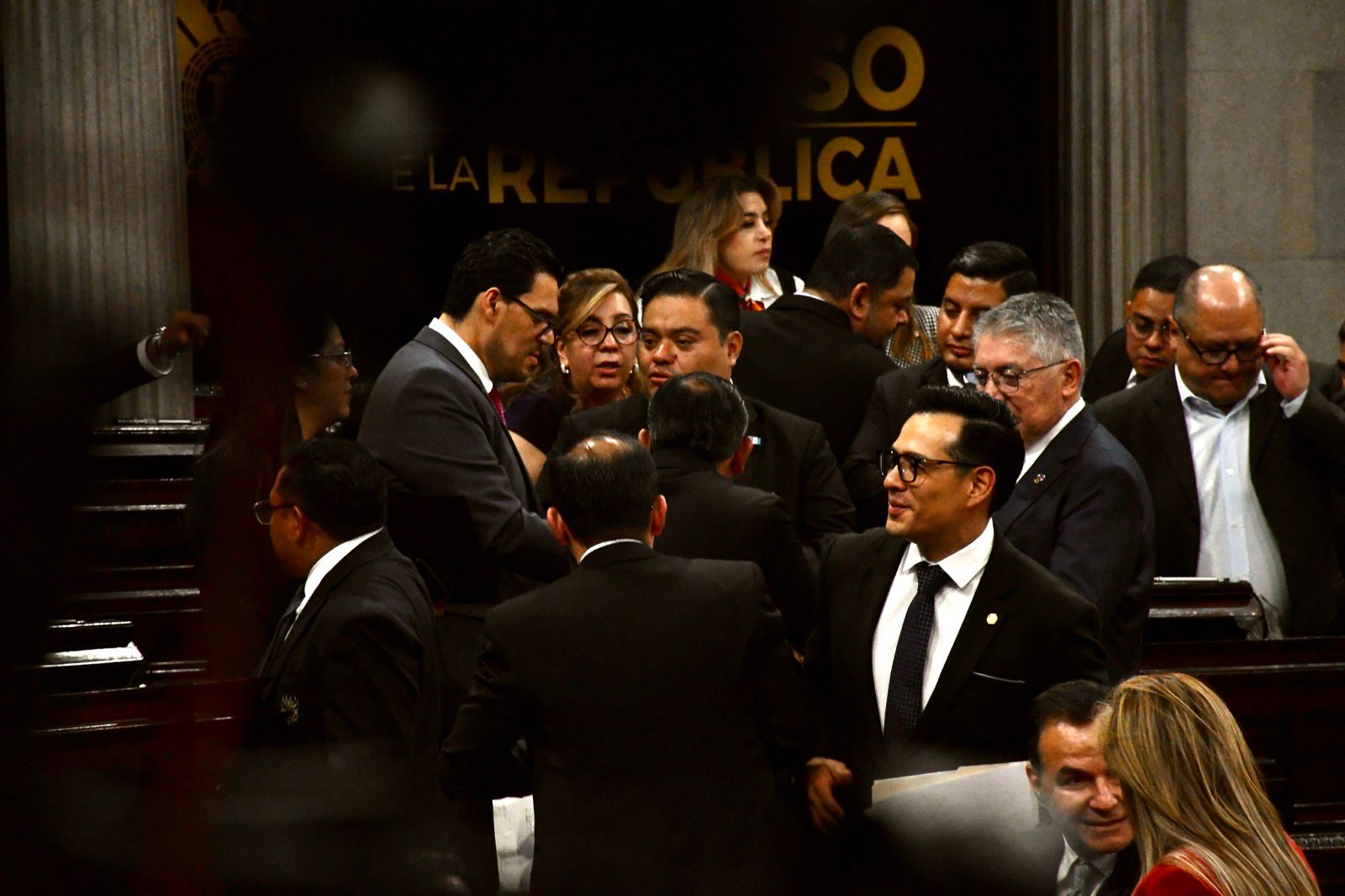
The Congress of the Republic, finally and after three weeks of discussion, approved this Tuesday, April 14, a fuel subsidy; a response to the escalation of fuel prices, due to the conflicts in the Middle East.
The subsidy, which consists of a State disbursement of Q2 billion, was achieved with the support of the majority of the deputies of Congress, after a day of negotiations led mainly by the ruling party José Carlos Sanabria.
With this contribution, approved as a national emergency, a direct contribution of Q5 is allocated for each gallon of super and regular gasoline, and Q8 for each gallon of diesel. These fuels have had a very rapid increase as a result of international prices, driven by the conflict between the United States and Iran in the Middle East.
Negotiated motion
At 7:20 p.m., José Carlos Sanabria asked that the session be interrupted, which had spent the last hour reasoning the votes of deputies who supported the approval of the Law to Prevent Child Sexual Abuse.
Sanabria, that while the votes were being reasoned in Congress, he moved between benches looking for the votes; He was even seen talking with leaders of the opposition benches. The official presented the motion assuring that he had the consensus to approve a subsidy; Five minutes later, 125 deputies had voted in favor of changing the agenda and beginning to discuss initiative 6756.
Luis Aguirre, Adim Maldonado, Elmer Palencia, Nadia Torres, Samuel Pérez, Allan Rodríguez, Inés Castillo, Felipe Alejos, Carolina Cifuentes, Jorge Castro, were some of the deputies who signed the initiative.
With the altered agenda, and multi-party support, it was requested that the subsidy be approved as a matter of national urgency. There were 120 votes that quickly gave way to the approval of the articles. In the plenary session, 131 deputies were marked.
The approval in a single debate passed even faster, confirming the broad consensus that was achieved to approve the subsidy, after three weeks of technical and political debates.
The details
The subsidy is a fund of Q2 billion that will be delivered directly to retailers for a period of two months or while the funds last.
The resources will be incorporated into the State Budget as an expansion that is the responsibility of the Ministry of Public Finance, through budgetary rearrangements that do not exceed Q1,192 million. If the resources have not been exhausted at the end of the three months, the Treasury portfolio may redirect them.
The subsidy, although it must have cross-checks with the Superintendency of Tax Administration, remains under the administration of the Ministry of Energy and Mines, who, together with the Ministry of Economy, will verify that the support reaches the consumer.
The temporary law mandates that, in the budget readjustment, the Ministry of Communications suffers the most significant reduction, with Q1.1 billion reduction, which consists of Q550 million of rearrangement in portfolio expenses, Q350 million in the State Building Construction Unit and Q200 million for the General Directorate of Roads. The Ministry of Defense will have a reduction of Q200 million and Q58 million that will be subtracted from the budget of the Ministry of Agriculture, Livestock and Food.
The discussion in recent weeks revolved around the possibilities of approving a subsidy with mixed financing: state funds and tax reductions; However, the final agreements were to only finance it with State resources.
Among the amendments, a group of opposition deputies managed to include in the final articles a containment of spending, which calls for rationing, with reports to Congress, expenses on travel expenses, use of official vehicles, unnecessary property rentals, food and public events.
An attempt was also made to include, without success, an article so that public sector entities can approve teleworking when possible and this measure is also recommended for the private sector, in positions where it is compatible. In both cases, it is clarified that they will be temporary measures.
The new temporary support law will also need a regulation, which Congress ordered that the Ministry of Energy and Mines must have ready within the next five days after the regulations come into force.
*Stay up to date with the Now newsletter. Key information at the moment it happens. Subscribe here.
#Congress | With 120 votes in favor, the plenary session of the Congress of the Republic of Guatemala approves as a matter of national urgency the initiative related to the fuel subsidy. pic.twitter.com/qN8BOaL0Xh
— Oscar Vásquez Mijangos (@oa_vasquezz) April 15, 2026
#Congress | Deputy José Carlos Sanabria presents a motion to modify the agenda and immediately hear about a fuel subsidy initiative in the face of rising prices.
The motion is approved with 123 votes in the plenary session of the Congress of the Republic of Guatemala. pic.twitter.com/S2Mek7mjEs
— Oscar Vásquez Mijangos (@oa_vasquezz) April 15, 2026