
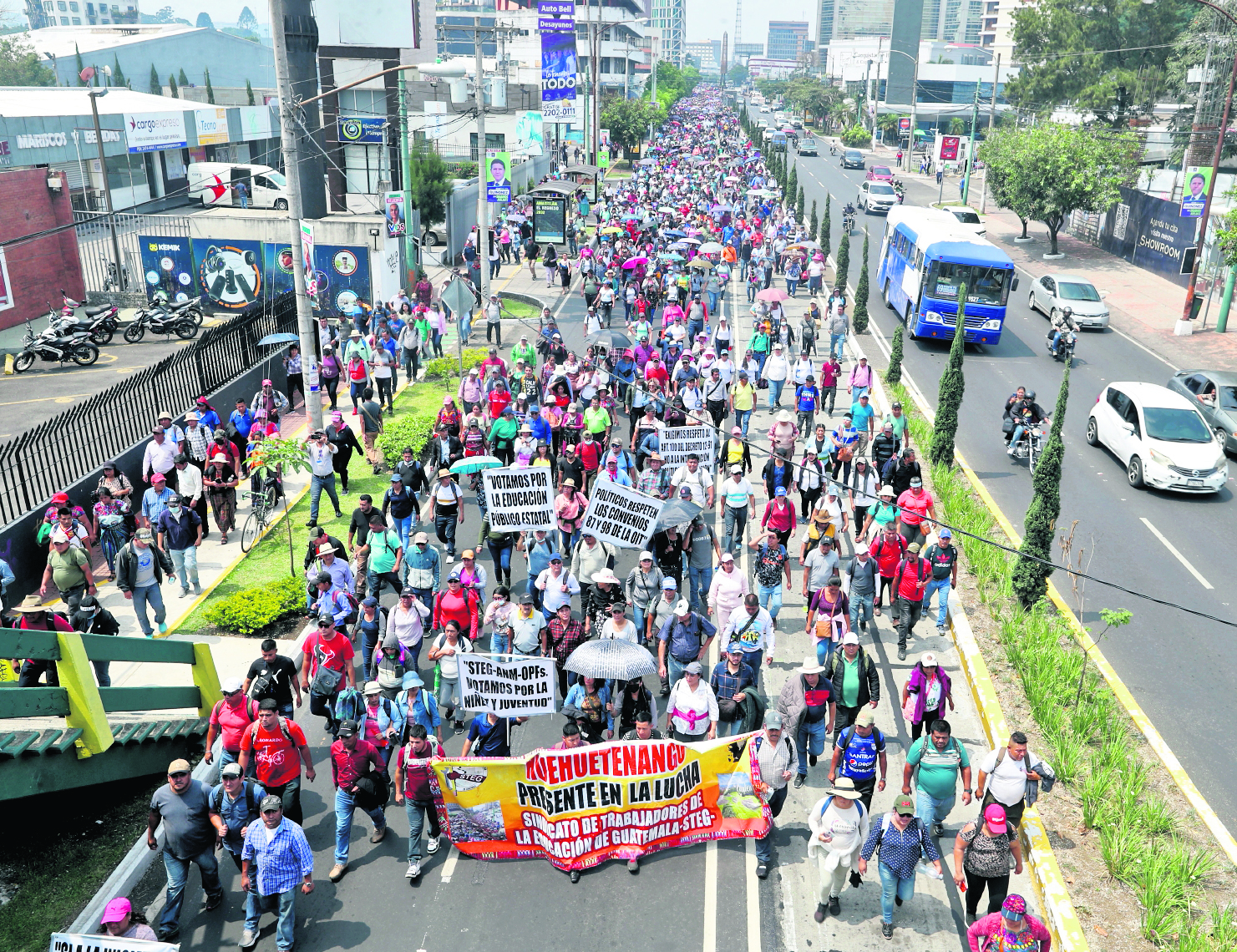
The location to the Ministry of Education (Mineduc), promoted by the Guatemalan Education Workers Union (STEG), paused the agreements reached in the 778 days How long did the discussion last? of the new collective pact on working conditions for teachers.
The dialogue between began on March 6, 2024 and ended on April 22 of this year, when the Court of First Instance for Labor Misdemeanors of the department of Guatemala processed the legal action promoted by the group led by Joviel Acevedowith which the process “is elevated to the judicial sphere” and “the negotiation breaks down,” according to Minister Anabella Giracca.
But STEG messages spread on social networks indicate that the summons does not break the negotiation, but rather transfers it to “another instance”, where workers are protected against dismissals and acquired rights are protected, in accordance with Guatemalan legislation and international agreements.
According to the ministry’s balance sheet, during the time the discussion was held Agreements were reached on 80% of the articles of the new collective pact; It was in those that have an economic impact and that violate the stewardship of the portfolio where there was no progress.
Due to the location, the meetings every Wednesday with the representatives of Mineduc and STEG were canceled and, while the course of the negotiation is resolved in the courts, the collective agreement approved in 2022 remains in force, and what has been discussed since 2024 only remains on paper.
What is lost
In a review of the minutes that were drawn up after each meeting between Mineduc and STEG, it can be established that a good part of the articles discussed in the new negotiation remained as they appear in the 2022 collective agreement. However, Some changes were made that benefited workers and others aimed at resuming the leadership of the ministry, which now are without effect.
Workers lose the increase in days of paid leave and holidays that had been agreed upon in the new pact: two more days leave for the death of family members and for the birth of the wife or partner; while they added 10 days to those already established for the postnatal period.
Furthermore, it had been achieved May 10 break for mothers, June 17 for parents and October 5 for all workers for World Teachers’ Day. The holidays that were held on a weekend would be taken on business days.
On the other hand, the Mineduc had regained control in the training to the ministry staff, since they no longer had to “agree” with the union, only inform. Also, that training activities not included in the pact would be carried out during non-working hours.
With the judicialization of the collective agreement, these achievements will not take effect, since the negotiation broke down.
🚨 The STEG proposed a new location and with this the negotiation of the collective agreement ends. They knew that the #mineduc He would never give in to the illegitimate privileges of his leadership.
📚 ⚖️ A new stage begins: the right to education is not negotiated. pic.twitter.com/BjxkuQZf8g
— Mineduc Guatemala (@MineducGT) April 26, 2026
What was not discussed
On July 24, 2024, Mineduc and STEG agreed that all articles with economic impact They will be addressed en bloc until the end of the negotiation of the new collective agreement.
On that list were the postmortem compensation —in the 2022 pact there were 10 minimum wages—, the professionalization bonus and the annual —Q700 and Q2 thousand 500, respectively—, and the salary adjustment —set at 3% of the base salary—.
Disagreements in sections with economic impact generated tension from the beginning. In October 2024, it was agreed to develop a route to address them. The STEG presented a proposal and the Ministry of Education evaluated its viability. In that interim, the Directorate of Financial Administration (DAFI) carried out a technical and financial analysis and ruled that the ministry did not have the budgetary capacity to assume the union’s demands.
The insistence of the unionists of not advance Until there was a counterproposal from the portfolio for these economic improvements, the negotiation stopped, as can be seen in each of the minutes from October 8, 2025.
Last year, the Ministry of Education granted a 5% salary increase to the teachers. Francisco Cabrera, Vice Minister of Education, says that the benefit is maintained and it was a decision that the authorities made far from the negotiation with the union. However, in the discussion of the new collective pact the STEG could look for another raise; Now that the process has been judicialized, this possibility has been lost.
It clarifies that, although the 2022 collective agreement is still in force, the articles with economic impact included therein only have effect for the years specified in the document.
What is preserved
With the location to Mineduc The approved collective agreement continues in 2022 and, with it, union leaders maintain irremovabilitylicenses to exercise union activity and for training. For workers, working hours, training, and procedures do not change. 180 days of classesamong other general topics.
The support programs For the benefit of teachers and students, the following continue: the teaching bag, subsidy to acquire technological equipment for teaching purposes, the free fund, provision of school supplies, textbooks and school meals. This point was also approved in the new negotiation, except for the School Medical Insurance, which was replaced by the School Health Program —resolution of the Constitutional Court—.
Read also: Collective pact: support programs for students and teachers continue
They also maintain the mixed boardswhose function is to resolve labor conflicts in a conciliatory manner and prevent them from going to court. However, its role has been distorted, since as a result of the collective agreement its incidence and participation have been increasing in matters that are the sole responsibility of the Mineduc authorities, such as decide on hiring or relocation of teachers, or about when and how to make the calls, without considering the weighting table.
Cabrera states that the figure of the mixed boards “is not the problem” and that they will continue to function, but that interference in administrative processes that only correspond to the nominating entity is what the Attorney General’s Office (PGN) raised in a unconstitutionality action against seven articles of the pact before the Constitutional Court (CC), in May 2025. To date, there is no final resolution.
“The ministry’s position in the negotiation was always that we cannot agree on things against the main interest of the educational system,” says Cabrera.