
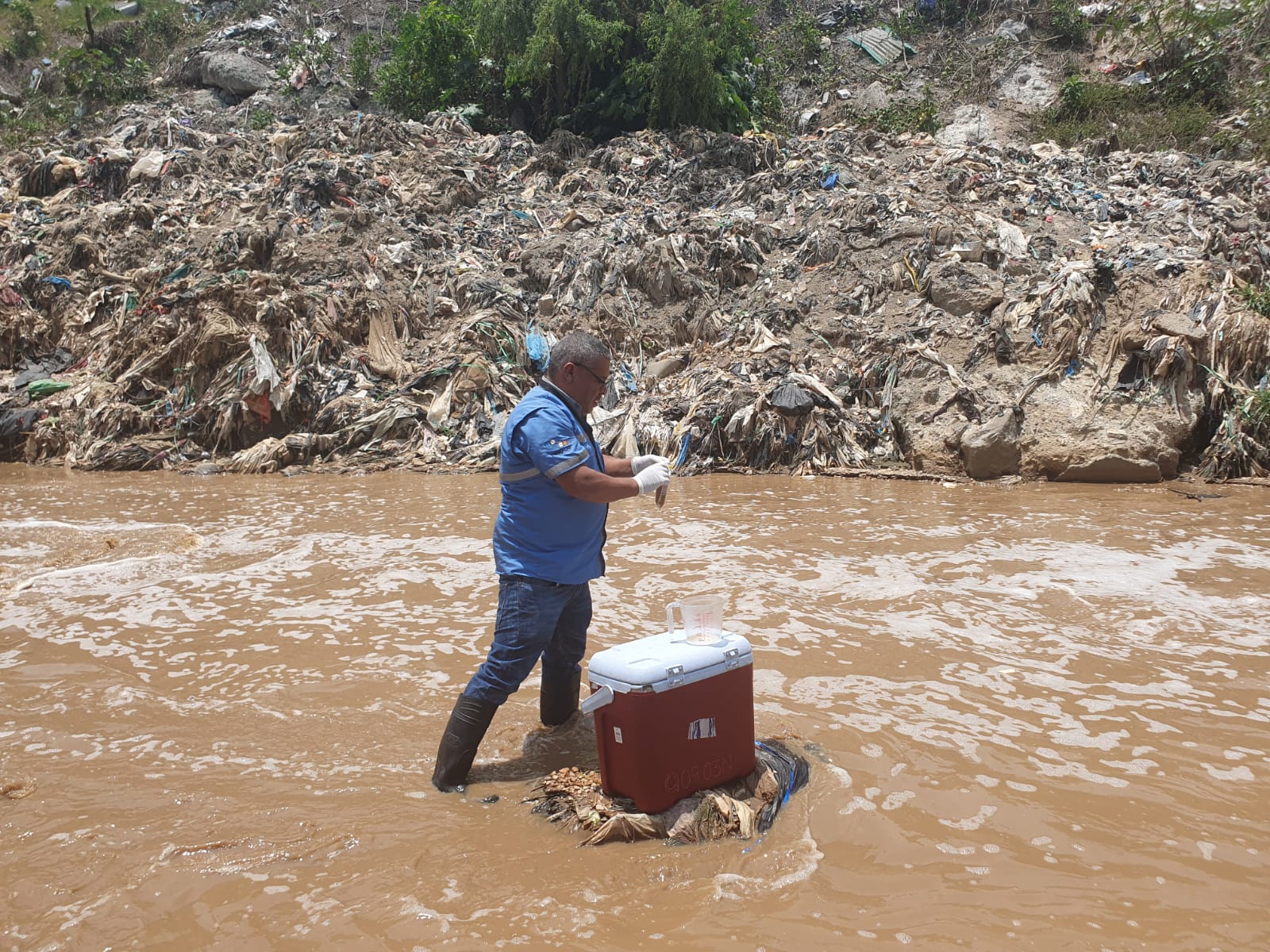
The water that is born crystal clear at three points where sampling was carried out is already contaminated, says a study carried out by the Alliance for Motagua Basin, the Municipal Development Institute (Infom), Innolab and FQB Lab, together with the International Rotary Club.
According to the study, the analyzes were developed after taking samples at three strategic points on May 7. The points were a birth located under the El Naranjo bridge, in Mixco; the Las Vacas River, after the zone 3 landfill overflows; and Santa Cruz Chinautla.
The analysis detected extreme levels of fecal coliforms, suspended solids and other contaminants in the water.
Fecal coliforms are indicators of contamination by human or animal excreta, and their presence is associated with gastrointestinal diseases and other infections.
The results warn of direct risks to human health, especially in children, and show that a large part of the capital’s wastewater ends up degrading the Motagua basin.
What surprised the researchers most was that even the water source analyzed, which appears to be cleaner, already had fecal contamination.
“We are putting the toilet on top of the sink,” Luisa Fernanda Barrientos, from Innolab, summarized during the presentation of results, describing a situation that she described as “spooky.”
According to the study, in the spring under the El Naranjo bridge, 23 thousand MPN (Most Probable Number) of fecal coliforms were detected per 100 milliliters of water, an unequivocal sign of contamination by fecal matter and microorganisms potentially dangerous to health.
The most critical point was identified in the Las Vacas River, downstream of the landfill in zone 3 of Guatemala City. There, 1.6 million NMP/100 ml of fecal coliforms were recorded, a figure hundreds of times higher than the limits allowed by international regulations used as a reference during the study, where it should not exceed one thousand NMP/100 ml.
Sampling result
Sampling point Fecal coliforms
- Puente El Naranjo Birth: 23 thousand NMP/100 ml
- Las Vacas River: 1.6 million NMP/100 ml
- Santa Cruz Chinautla: 1.6 million NMP/100 ml
The above figures are hundreds of times higher than the reference standards of countries such as Mexico, Costa Rica and Peru, the study adds.
The researchers pointed out that this point of the Las Vacas River receives leachate from the landfill, as well as wastewater discharges from neighborhoods, industries and urbanizations.
“We are killing the river,” Barrientos warned.
The situation is repeated in Santa Cruz Chinautla, where 1.6 million NMP/100 ml were also detected, confirming that the contamination remains downstream and directly affects communities where thousands of people live.
According to specialists, constant exposure to microorganisms present in contaminated water can cause recurrent diarrhea, intestinal infections, hepatitis A, amoebiasis, giardiasis, cholera, dysentery and typhoid fever.
These contaminants have filtered into the water table and, as revealed by Infom, the water from the stream coming from an artisanal well located a few meters from the river “is no longer drinkable.”
During the presentation it was also explained that the continuous ingestion of these microorganisms, through the so-called fecal-oral route, keeps the digestive system in a permanent state of inflammation.
This condition, pointed out by experts with more than three decades of studying water pollution, can affect the absorption of nutrients and is linked to the high prevalence of chronic childhood malnutrition in Guatemala.
In addition to infectious diseases, researchers warned of possible effects related to alterations in the physical and cognitive development of the population exposed for long periods.
Another alarming finding was the amount of suspended solids detected in the water.
Suspended solids generate extreme turbidity, prevent the passage of sunlight, affect the photosynthesis of aquatic organisms and reduce the oxygen available for fish and other species.
The analyzes also detected high concentrations of nitrogen and phosphorus, elements that favor the proliferation of algae and microorganisms that consume oxygen, which causes the death of aquatic fauna and transforms bodies of water into smelly environments unfit for human consumption.
Among the main contaminants identified are:
- Fecal coliforms
- Chemical and biochemical oxygen demand (COD and BOD)
- suspended solids
- Boron
- Nitrogen
- Phosphorus
According to the results, the contamination observed in Chinautla originates mainly from sources located in Guatemala City and Mixco.
The study concludes that the water emerges clear in the Las Vacas River, but becomes drastically contaminated almost immediately by domestic and industrial wastewater discharges.
The researchers pointed out that just a few meters after being born, the river begins to receive pollution from different urban areas, a situation that worsens after passing through the zone 3 landfill.
The specialists insisted that the problem transcends municipal borders, since all the pollution that reaches the Las Vacas River ends up entering the Motagua basin, the most important in the country.
“It is not an issue for one municipality; it is an issue that affects us all,” they concluded during the presentation.
The results reflect a worrying reality: the water with which thousands of Guatemalans live already shows signs of contamination from its origin, while some of the main tributaries of the Motagua basin show levels that represent a direct threat to public health and the environment.
Stay up to date with the Now newsletter. Key information at the moment it happens. Subscribe here.