
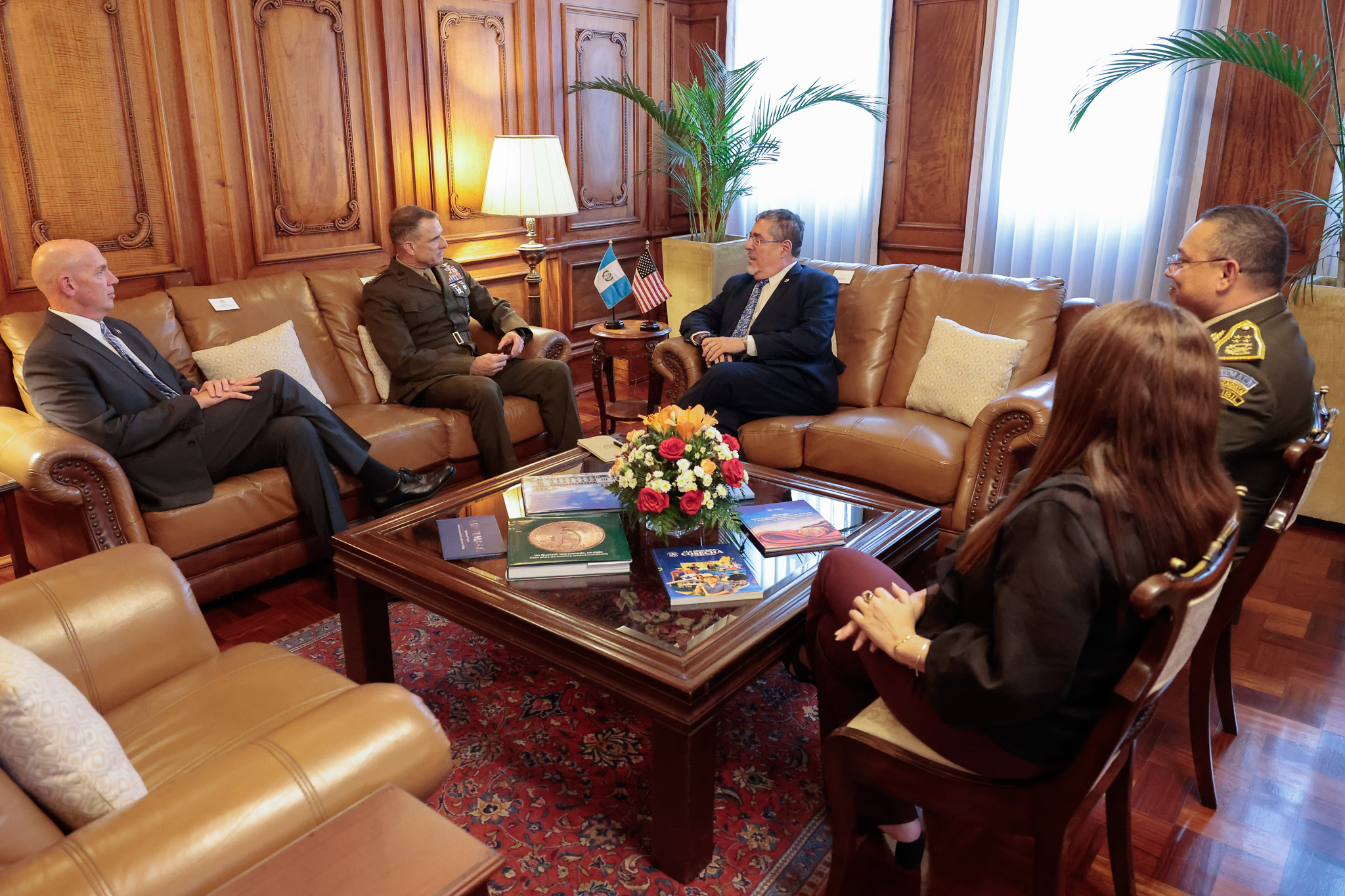
Military cooperation between the United States and Guatemala is at the center of the debate due to the recent statements by the Secretary of Defense of that country, Pete Hegsethon military operations in Guatemalan territory and in Ecuador, in the short term, aimed at combating narcoterrorist structures.
Until now, President Bernardo Arévalo has assured that military cooperation with the neighboring country is merely on technical and training issues.
“We have been clear in the type of support request we have made around equipment, training, trainers, counselors, integration of intelligence information systems, so that we can work very effectively and as we have always done, within the framework of current Guatemalan legislation,” Arévalo stated last Monday during a press conference.
Meanwhile, United States negotiations are advancing in the region. The head of the Honduran Armed Forces, Héctor Valeriodeclared to the media in his country, this Wednesday, about the negotiations that are being carried out with the United States to carry out joint military operations to combat drug trafficking and organized crime.
At the discretion of experts in international affairs and security, if an agreement is reached “Guatemala could lose a lot of ground” as a strategic partner and would put at risk the progress made with the United States both at the military level and in other aspects, by not defining or having a clear position regarding joint military collaboration with the northern country.
Lack of leadership
The former vice chancellor and internationalist Luis Fernando Andrade Falla presents an unfavorable outlook, considering that Guatemala is losing the opportunity to consolidate itself as a strategic partner of the United States in the region. This, due to the “ambiguous” stance and “lack of leadership” of President Bernardo Arévalo in terms of directing communication and approaches with Washington, mainly with Donald Trump, on important and current issues, not only for Guatemala, but also for the entire region.
“There is no clarity, strategy or disposition. And that is due to a lack of leadership, of vision. And of leadership and vision, not only national but also regional,” says Andrade and considers that President Arévalo “has appeared to have a good relationship with the United States, which exists because there is cooperation, but there is a certain political level that makes things go beyond what is being done.”
“We are a year and a half away from the president finishing and he was not invited to Miami – meeting of the Shield of the Americas – those meetings at the political level can be used for many things to benefit the country,” says the former vice chancellor.
Andrade Falla indicates that the country must be a “regional leader” and the statements of the Secretary of War, place it in first place in matters of cooperation and the “strategic” role that it has for the United States, but it cannot be realized due to the lack of political clarity from President Bernardo Arévalo, who assures “he does not exercise direct communication” within the negotiations and communication with Donald Trump, delegating approaches to the Ministry of Defense in matters of military cooperation.
“There is a great opportunity to raise the levels of cooperation, to visualize a role for Guatemala at the regional level in terms of coordination based on shared threats,” he assured.
Guatemala’s position on Honduras
Andrade Falla explains that, although Guatemala has great historical and geographical weight, key because it has a border with Mexico, has failed to take advantage of the opportunity to lead policies in the region. From this account, he considers that, due to the negotiations that are being carried out, Honduras could get ahead of Guatemala, which could be poorly positioned.
“If Honduras accelerates its process – of negotiation with the United States – Guatemala would remain as a country that is effectively not in the position to make an extra effort,” he says.
For his part, Óscar Morales, analyst in legal and security affairs, considers that there are already bilateral agreements between Guatemala and the United States, although these have not been made public and in detail. It also indicates that, in the case of Honduras, the United States shows it as an example that it is expanding its presence in the region and that due to this situation Guatemala “cannot be left behind.”
“The case of Honduras is a case where it has been clearly stated that the agreements are going to happen and that they are going to be positive. The United States is entering the region and is entering for a justified reason, which is the fight against corruption and criminal groups, and it is going to enter all those territories that suit them or that they create, for strategic reasons, for their fight against these crimes,” says Morales.
Regarding the agreements reached between Guatemala and the United States, Morales believes that, whatever they may be, The Executive must make them public to strengthen trust between both parties. Although it is necessary to maintain a good relationship with the northern partner, he affirms that the Government should not neglect the right of citizens to be informed.
“Guatemala must be careful not to damage cooperative relations with the United States, but it must also be clear that citizens deserve to know what the objectives of these efforts, these collaborations and the negotiation frameworks that both countries are having are,” he says.
Regarding the issue of sovereignty, which has been cited repeatedly, Morales affirms that this concept should be expanded in the face of the global reality represented by drug trafficking and organized crime.
“I believe that the issue of sovereignty has already been overcome by the globalized exchanges that exist throughout the world, mainly now in matters of security. Organized crime transcends and affects other territories and it is difficult not to be able to combat it due to the issue of sovereignty,” he assures.
Should clarify doubts
Former Vice Chancellor Luis Fernando Andrade Falla concludes that President Bernardo Arévalo cannot continue with an “ambiguous” and unclear position regarding the scope of bilateral collaboration with the United States.
“I urge President Arévalo to definitively clarify this situation, which cannot remain ambiguous. In the rounds, they ask many things and in one minute he – Arévalo – acts crazy and does not focus on certain fundamental issues and this issue which we are addressing deserves an exclusive and direct interview to clarify public opinion,” assures Andrade Falla.