
The technical discussion on the amendments to initiative 6593, called “Comprehensive Law against Money Laundering or Other Assets and the Financing of Terrorism”, will continue next Monday, with a view to achieving consensus and political agreements in the Congress of the Republic.
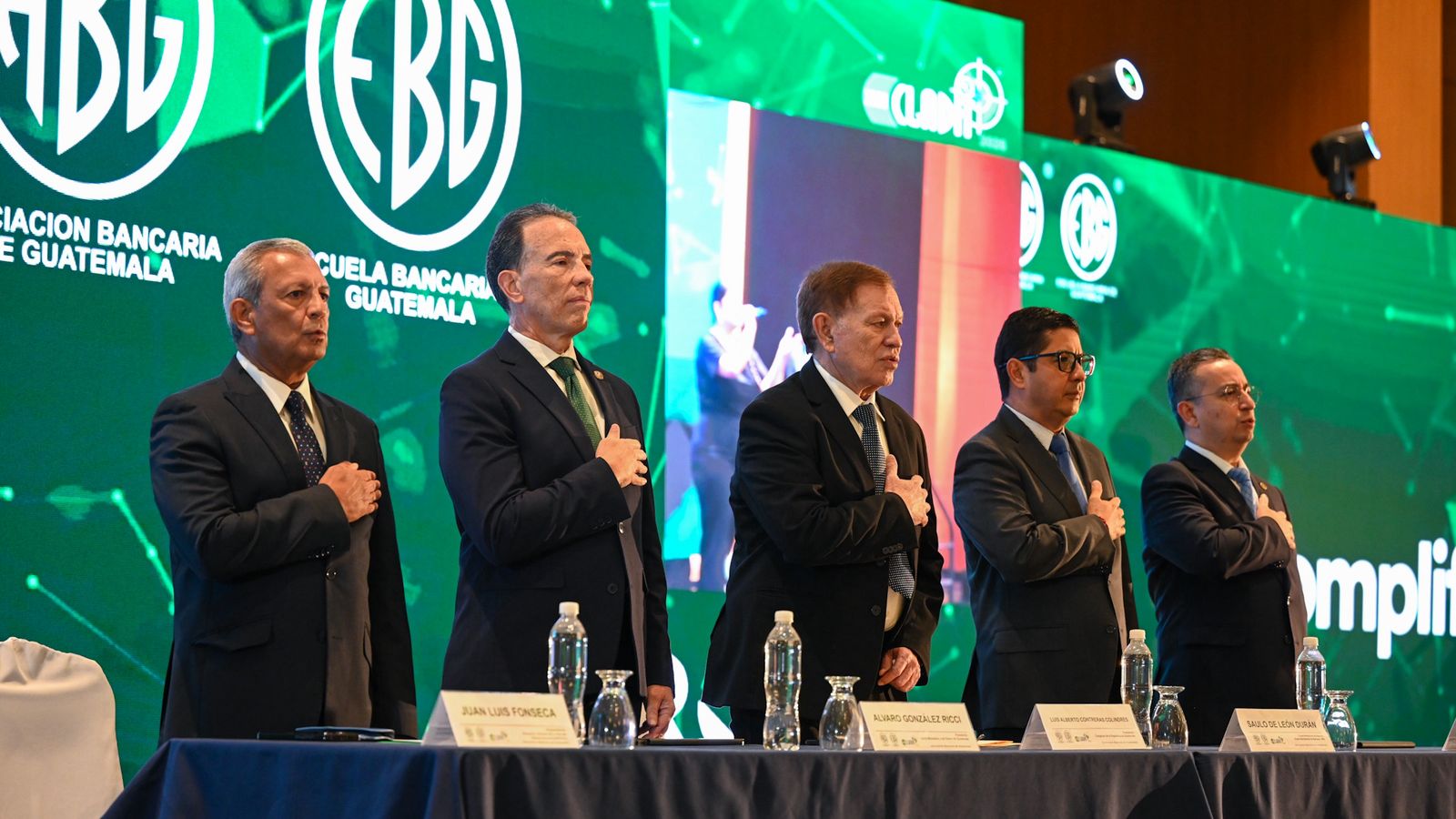
The process of discussing amendments to the bill, also known as anti-money laundering, was agreed upon in the Legislature in search of political consensus, explained Luis Contreras, president of Congress, after participating in the XXIII Regional Congress for the Prevention of Money Laundering and Financing of Terrorism (Cladit), organized by the Banking Association of Guatemala (ABG).
The technical teams of the Special Verification Intendency (IVE), which is the financial intelligence unit (UIF), and the Superintendency of Banks (SIB), as well as representatives of the ABG and the Chamber of Finance of Guatemala (CFG), among others, will participate in the discussions.
“The program is that on Monday (May 25) we will be again with block heads, with the Economy Commission and with the advisors we have; the IVE, the SIB and the ABG,” highlighted Contreras.
He mentioned that “this law has some gaps, according to us, that we want to fill,” but “we do not want to harm the law so that we can pass the evaluation of the Latin American Financial Action Group (Gafilat).” He reiterated that the deputies want to approve the law.
Guatemala will be evaluated by Gafilat regarding compliance with an updated standard on the prevention of money laundering.
Fine tunes changes to anti-money laundering law
When asked about the observations that exist and that will be addressed next Monday, Contreras explained that there are “some things there” and cited public notaries as an example, which he considered an issue “very strong for us.”
“The notary public has three functions: register, register his clients and report. In other words, he has a quite complicated job,” he said.
In this regard, he added that they have tried to ensure that they are not hit so hard. There are also penalties of Q500 to Q350 thousand. “An entrepreneur, who is a notary, who at the beginning you hit him with a penalty of Q200 thousand, I don’t think it ends,” he justified.
To this end, Contreras remarked, We are looking for how to make that more flexible, If you can, since unfortunately those are international standards. “It will be very difficult for us to help them with that,” he justified.
Another aspect concerns Politically Exposed Persons (PEP), which exposes the Gafilat and the discretion over who is included. “The deputies would like it to be the first degree of affinity and the first degree of consanguinity,” he added.
He exemplified that the aim is to include children and spouse.
Law will return to the plenary session
Contreras announced that, With the results of the technical table obtained on Monday for the anti-money laundering initiative, sessions have been scheduled for June 2 and 3, since the nominating commission will be convened for the process of electing the new head of the Comptroller General of Accounts and the law will be scheduled.
“The program is that on Monday (May 25) we will be again with block heads, with the Economy Commission and with the advisors we have; the IVE, the SIB and the ABG.”
Luis Contreras, president of the Congress of the Republic
The National Port System Law initiative would also be scheduled.
He clarified that the port law still has time and can wait a few more days, and that it is not as urgent as the anti-money laundering law, which has expiration dates.
Trust consensus on anti-money laundering law
For the head of the SIB, Saulo de León Durán, at this stage of discussion in Congress there is enthusiasm and very positive aspects, since the deputies have raised their doubts and there is openness to reasoning.
He indicated that it is necessary implement a technical standard, but that at the same time establishes and is aligned with the constitutional principles of protection.
“We are very happy, we are waiting for a meeting next Monday with the IVE team and the block heads to discuss the latest amendments. We are very sure that both the deputies are open to understanding what the technical needs of the law are, and we have taken into account their concerns so that they fit properly into the Guatemalan system,” he highlighted.
As for whether the discussions are about form or substance about the initiative, De León Durán responded that there are all kinds. “We can say that it is substantive because we are talking about the suspicious transaction report, and talking about the suspicious transaction report is extremely important because it is the mechanism that private entities use to report any anomalous transaction, but obviously it all comes down to wording.”
In any case, he pointed out that it is a matter of drafting and being able to assimilate into regulations what Guatemala needs in technical terms and what the deputies raise as constitutional questions.