
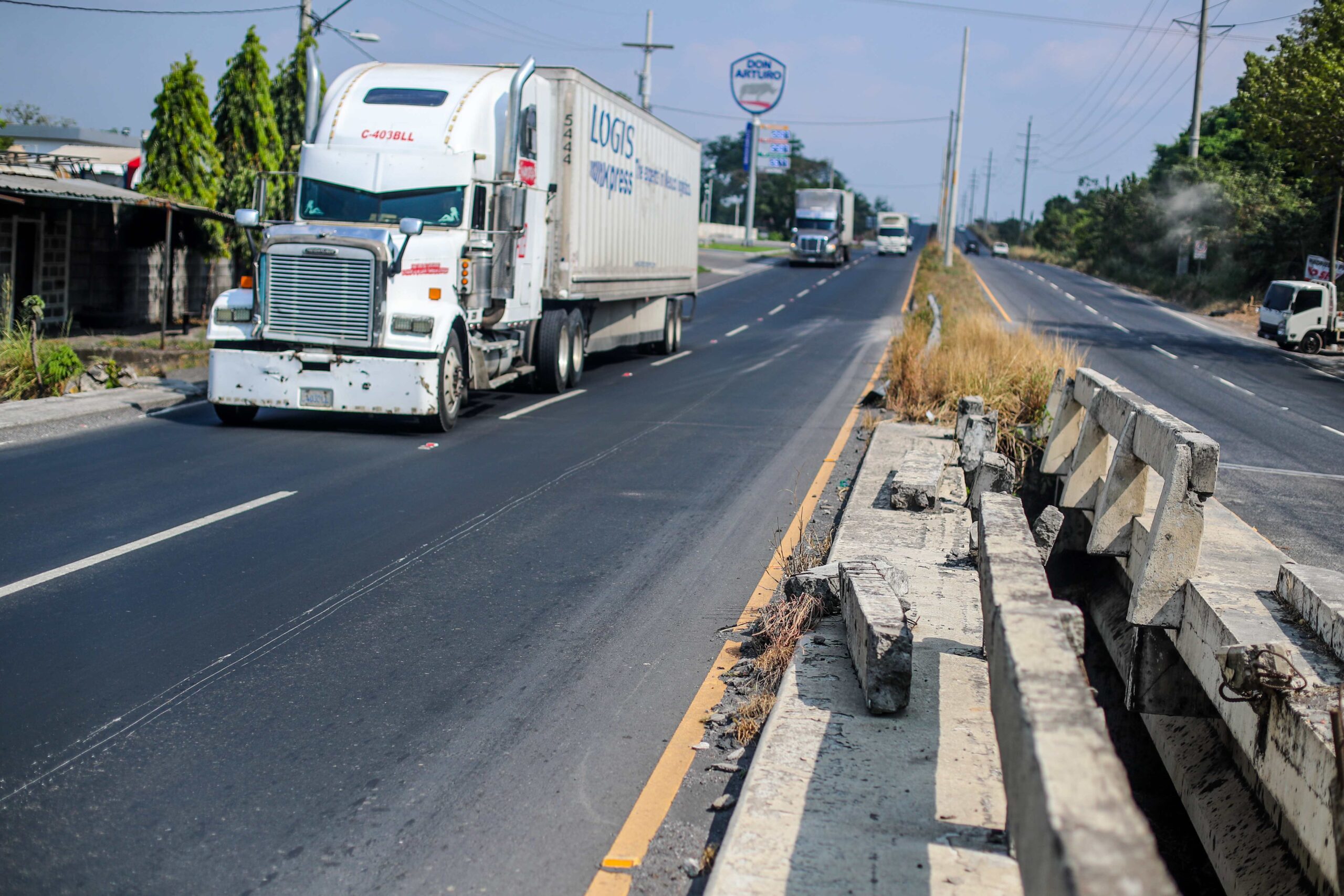
Guatemala has plans, planning tools, budget, public investment systems and support from international organizations to promote infrastructure projects. However, the main challenge remains to convert these priorities into executed works.
That was one of the main conclusions of the Construction Economic Bulletin Forum (BEC), organized by the Guatemalan Chamber of the Construction Industry (CGIC), under the theme “Infrastructure and competitiveness: from planning to the executed work.”
Representatives from the Planning and Programming Secretariat of the Presidency (Segeplan), the Directorate of Priority Road Projects (DIPP), the World Bank and the private sector participated during the activity, who agreed on the need to strengthen institutional coordination to reduce the delays that have historically affected public investment.
José Ardón, executive director of the CGIC, explained that various andStudies carried out by the chamber have shown a disconnection between the projects identified as priorities and their materialization in infrastructure. “Many times there is a separation between the planning and the execution of a work. Something happens along the way that prevents the completion of all these projects that we have identified as a country,” he stated.
According to Ardón, the obstacles are usually found in administrative procedures and coordination difficulties between institutions. Added to this is the lack of mechanisms that allow projects to continue during changes in government. “There are plans that are not linked to financial elements and, therefore, end up being deprioritized during changes in government or even from one year to the next,” he noted.
The manager added that The discussion on infrastructure should focus on how to accelerate public investment and ensure that prioritized projects have financial, institutional and technical support enough to reach the execution phase.
Segeplan reports reduction in times
The Secretariat of Planning and Programming of the Presidency (Segeplan) assured that in the last two years it has promoted changes in the National Public Investment System (SNIP) to reduce project evaluation times and streamline investment processes.
The undersecretary of Segeplan, Enrique Maldonado explained that one of the main adjustments consisted of applying a criterion of proportionality to the requirements that the projects must meet. According to him, previously the same documentation was required for a small project as for an initiative valued at hundreds of millions of quetzales, which slowed down the approval of investments.
“There was a huge debt in the sense that a project of Q1 million was asked for the same as a project of Q500 million,” he stated. Given this, the institution began to evaluate each proposal according to its amount, level of risk, complexity and other technical criteria, with the aim of reducing administrative burdens.
Maldonado assured that the changes are already showing results. As an example, he indicated that the time to issue a technical opinion on rural electrification projects went from 18 to five days. Besides, He pointed out that during 2025 Segeplan issued a favorable opinion for more than 10 thousand projects and that, at the end of May of this year, more than five thousand files had already been submitted.
The official also highlighted an increase in the project approval rate. According to the data presented, this went from 33% in 2024 to 56% in 2025. As of May 2026 it stood at 45%, while the average time to issue a favorable opinion was reduced to eight days.
Nevertheless, recognized that streamlining planning does not alone solve the infrastructure problems facing the country. “We recognize that one thing is achieving approval of projects and another is execution, which is where improvements must be made,” he said.
Maldonado added that one of the challenges is to strengthen the pre-investment phase to identify risks, guarantee the technical feasibility of the works and avoid problems during execution. “If we want to increase investment spending, we must be clear that increasing investment spending today means increasing operating spending tomorrow,” he stated.
In that sense, he recalled that infrastructure requires permanent resources to operate and maintain. “Roads need maintenance, hospitals need staff, and schools need teachers and technical resources,” he said. In his opinion, the discussion about infrastructure should not focus only on how much is invested, but also on the State’s capacity to sustain those investments in the long term.
The undersecretary also pointed out that Segeplan is working on the modernization of the public investment computer system and the interoperability of state platforms to improve project monitoring.
As he explained, the lack of connection between systems makes it difficult to know precisely who executes the works, how they progress and what results they generate. “If we want to know who is the executor of a work, we have to follow an entire search route. It would be very different if the systems were interconnected,” he stated.
They ask to launch the DIPP
Another issue addressed was the situation of the Directorate of Priority Road Projects (DIPP), created to develop strategic road infrastructure projects, but which still faces challenges to fully begin operations.
Asked about this, Ardón indicated that, From the perspective of the construction sector, the current regulations already provide sufficient tools to begin implementing the model contemplated in the law.. “From the sector we recognize that the law is not perfect, but we have the tools and mechanisms currently with the law approved and in force that should allow us to begin applying it,” he stated.
The director pointed out that the country has dedicated a good part of the debate to possible legal reforms, when one of the immediate challenges is to complete the pending regulations and allow the institution to begin operating.
Claudia Cáceres, general manager of the DIPP, confirmed that the regulation is still under review and that it was recently returned by the Attorney General’s Office (PGN) with observations.
As he explained, the observations were analyzed in a technical panel made up of advisors from the institutions that make up the DIPP board. “The observations were already addressed, the arguments of how they were incorporated or, in some cases, why it was not legally appropriate to incorporate them,” he indicated.
Cáceres pointed out that Currently, work is being done on the integration of the file to send the regulations back to the PGN. “I hope that by the middle of next week, at the latest, the regulations will be back in the PGN so that they can get to know it again,” he stated.
The official acknowledged that there are delays with respect to the deadlines established by law. “Yes, we are a little behind on the deadlines. The regulations had to be published in November of last year and we are almost in July 2026 and we still don’t have it,” he said.
At your discretion, The approval of the regulation is key because several of the mechanisms contemplated in the law depend on that instrument to begin to operate.. Among them is the Fund for Priority Road Infrastructure Works (Fovip), which must finance part of the institution’s activities.
“Much of this is tied to the regulations, because we cannot request the transfer of funds to Fovip because it is not created, and it cannot be created if there is no regulation that says how it works,” he explained.
Despite the delays, Cáceres assured that the entity continues working on internal regulations, specific regulations and job profiles to form the technical team that must operate the institution. “We will continue working on these issues so that when the regulation comes out we are ready and do not further delay the start of operation,” he stated.
Regarding expectations for the coming months, he indicated that The immediate priority is to obtain the endorsement of the PGN and move towards the publication of the regulations. “I would hope that the DIPP, in a couple of months, will be able to have the regulations issued,” he said.