
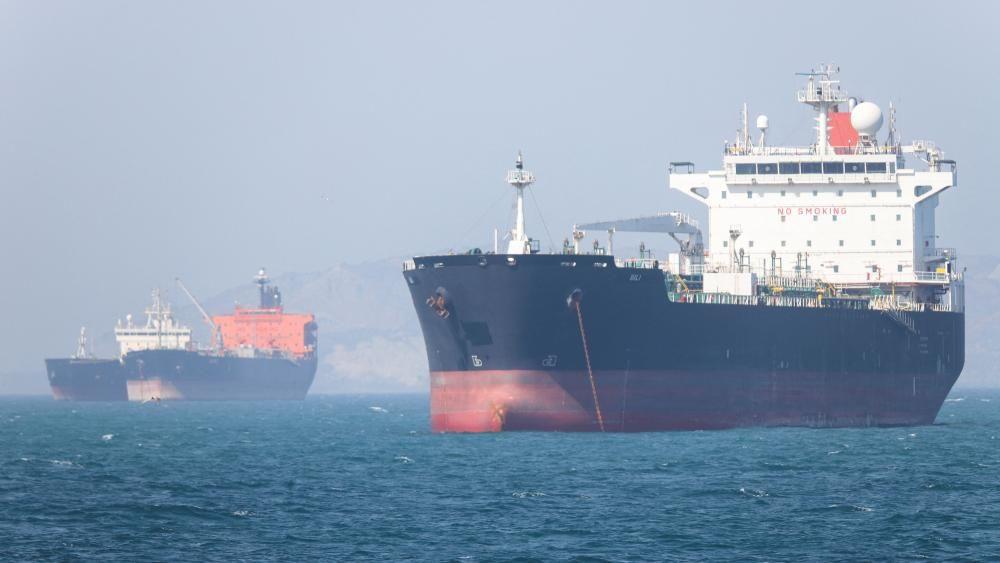
Although an understanding was reached that put an end to the geopolitical conflict and normalized the movement of ships through the Strait of Hormuz, factors that had generated tensions in the international price of a barrel of oil and raised it to US$100, the market has begun to register a decrease.
A downward trend in the price of crude oil is expected after reaching an understanding between the United States and Iran, so future prices for a barrel of Texas oil (WTI), a reference for Guatemala, would begin to reflect this decrease.
That is, the global market begins to discount the international uncertainty generated since the end of February in one of the main producing and transporting regions of oil and its derivatives.
For small economies such as those of Guatemala and Central America, these international agreements represent a relief, because they depend 100% on the import of petroleum products and could favor a reduction in their costs.
Hormuz sets the course for fuels
Enrique Meléndez, executive director of the Guatemalan Association of Gasoline Retailers (Ageg), presented an overview of what could happen in the short and medium term, especially in relation to the understanding reached this week.
Among his considerations he commented: “We must wait for the agreement between the United States and Iran to be consolidated and for the Strait of Hormuz to operate normally again. This energy scenario would give us a drop in the coming days, both in the price of oil and in that of its derivatives.”
In his opinion, and under this scenario, the manager stated that a normalization process would be developed, taking into account that it is necessary to reactivate oil production capacity and transportation logistics in the region.
Normalization depends on Hormuz
Meléndez recommended paying attention to behavior of Texas oil prices (WTI) and the trend they show in the coming days, since they could give signs of a stabilization of the market, including the national one.
He explained that a five-day average of international prices is currently used and considered that price stability will depend on the full reopening of oil tanker transit through the Strait of Hormuz.
He added that volatility could remain high because “global inventories remain low and, as mentioned above, the logistics — transportation — recovery will not be immediate.”
In any case, Meléndez declared that the normalization process will begin with the reopening of the Strait of Hormuz. He added that analysts have pointed out the need to consolidate oil tanker routes.
“We must wait for the agreement between the United States and Iran to be consolidated and for the Strait of Hormuz to operate normally again. This energy scenario would give us a drop in the coming days, both in the price of oil and that of its derivatives.”
Enrique Meléndez, executive director Ageg
Regarding the validity of the state subsidy on the price of the gallon, the director of the Ageg indicated that, for gasoline, Q5 per gallon, represents 14% of the price, while, for diesel, Q8 per gallon, it is equivalent to 25%. He added that these measures have contributed to maintaining the consumption of these products.
Measurements are currently being carried out to have more precise data on the effects.

Agexport sees relief from lower crude oil prices
For Francisco Ralda, president of the Guatemalan Association of Exporters (Agexport), the announcement of the understanding reached between the United States and Iran represents a positive expectation for the different productive activities, since fuels are an essential component of their operations.
He recalled that the price of oil, before the conflict, showed a stable trend around US$90 per barrel. Later, with the beginning of the crisis, it was in a range close to US$100 and, in some days, it reached up to US$120.
“We have seen a drastic decrease in the price of oil, which is around US$70,” he noted.
High costs hit competitiveness
The Agexport representative warned that it is important to determine what the future trend in the price of crude oil will be, since, as he noted, “we have seen announcements of peace agreements on numerous occasions.”
“Oil has been extremely volatile and we really hope that this time there will be a definitive ceasefire and that we will return to normality with oil prices between US$60 and US$70 per barrel,” he noted.
Ralda stated that the analyzes carried out for the export sector show that, during the first four months of the year, competitiveness has been affected by the increase in costs such as freight, inputs, fertilizers and rubber products. He added that these factors have reduced profitability margins.
He projected that, with a normalization of the oil price during the remainder of the year, there will be no major adverse effects on export activity and that derivatives will tend to stabilize and reduce gradually. “This could also be reflected in a reduction in the costs of land transportation of goods and passengers, which increased during the months of the conflict.”
TOLikewise, he indicated that maritime freight on the Asia-America route went from US$2,500 and US$3,000 to US$8,000. “These are very high prices that should be corrected soon and return to normal,” he said.
“Trade should normalize and freight costs should return to previous levels. This will happen gradually and we look forward to it because we are working with very hard margins,” reiterated the president of Agexport, Francisco Ralda.