
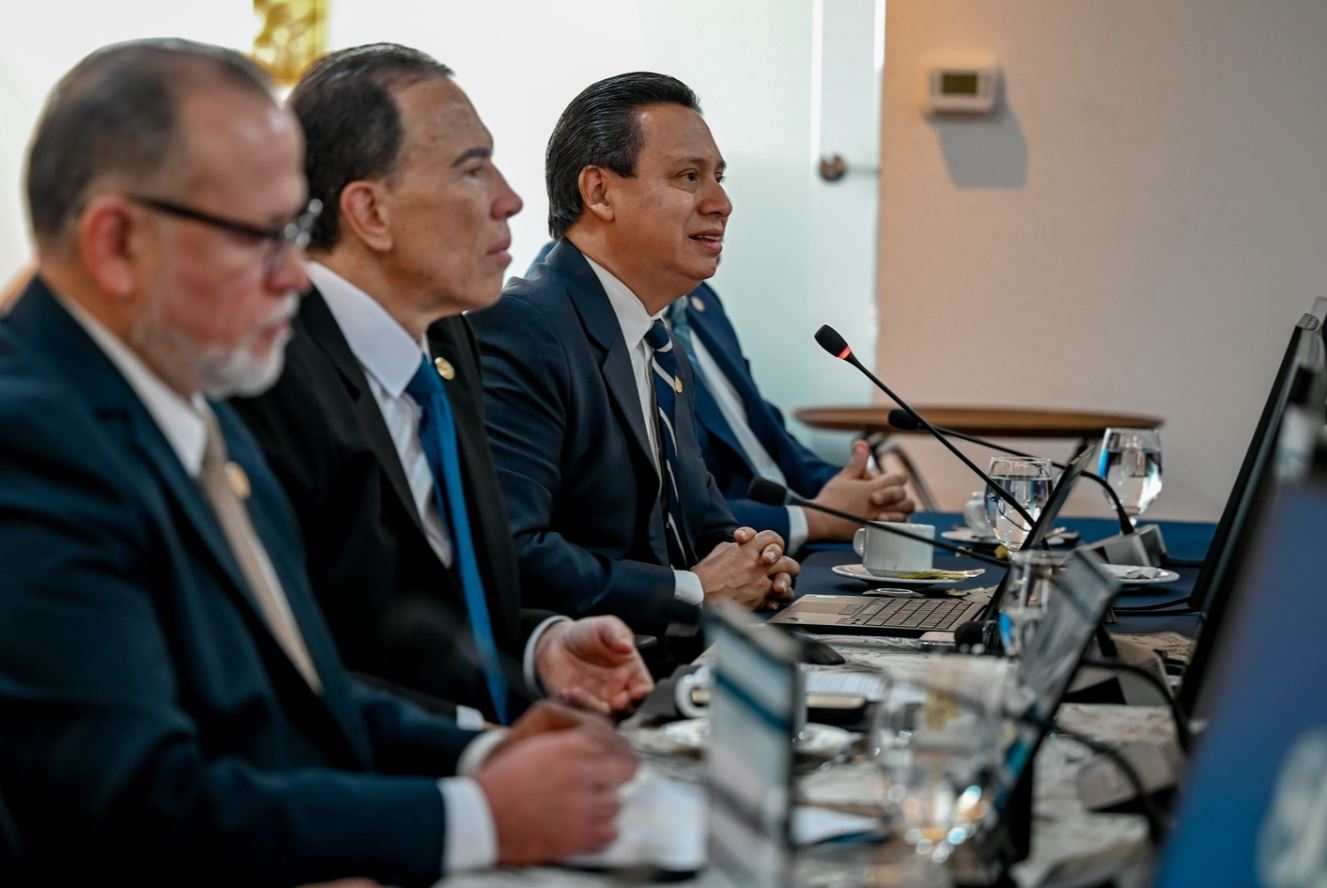
The monetary authorities of Guatemala presented the economic scenarios for the country after reaching an understanding between the United States and Iran last week, so the inflation and economic growth expectations for this year.
During a presentation on the country’s economic scenario and the performance of its variables, the authorities of the Bank of Guatemala (Banguat) confirmed that the ceasefire reduces the pressure, from an international perspective, on the evolution of several economic indicators in Guatemala.
Both inflation and the growth of national production will evolve in accordance with the original forecasts; However, when the conflict began at the end of February, a bias in expectations was generated due to the upward trend registered in the price of oil.
Johny Gramajo Marroquín, economic manager of the Bank of Guatemala, offered Free press a short-term vision.
How should we understand the evolution of the international environment from the economic perspective in Guatemala?
What we currently have is a memorandum of understanding. It is not yet a final agreement. The memorandum of understanding basically establishes a more formal ceasefire and opens the Strait of Hormuz for the transit of oil through that sea route.
CONTENT FOR SUBSCRIBERS
What are the implications?
Just the news that an agreement was going to be reached decreased the price of oil last Tuesday and Wednesday to levels around US$76 per barrel.
The price has had sessions with the market opening at US$73 per barrel, which is more or less where it has been.
So, if we compare it with the quotes we had, for example, a month ago, about US$100 per barrelbecause basically it is a 25% drop in the price of oil.
With this trend, what is expected in the short term?
The local price is quite influenced by the international price. We hope that prices in Guatemala will indeed begin to decrease to the extent that the drop in oil prices continues.
It must be clarified that this is preliminary. The final agreement is needed.
With the final agreement there would be an end to the conflict and with that there would no longer be pressure for that reason on the international price of oil.
How is this trend related to inflation?
Lower fuel prices in Guatemala generate a drop in imported inflation and this, then, what it does is reduce total inflation. We maintain our inflation estimate at 3.75%.
What other changes are observed in what was drawn up when the conflict began?
First, we no longer see upward pressures like we would if the conflict continued to prolong. In an environment where the conflict was prolonged, in reality the fear was that prices would continue to increase, that they would remain high and that then reducing inflation would be more difficult.
But that risk has now been diminished by the deal.
Those threats to both inflation and economic growth are reduced for this year…
Preliminarily, our estimates no longer present that marked upward risk in inflation and the risk that we saw for growth, which was a little downward, not as the International Monetary Fund (IMF) mentioned, but a decrease that could occur.
In reality, the increase in fuel prices affects inflation more than economic growth.
What scenario is there for the short term?
What we see now is a scenario in which compliance with current projections is very feasible, such as the original indicators of inflation closing at 3.75% by December 2026 and 4.1% GDP growth.
Just the news that an agreement was going to be reached decreased the price of oil last Tuesday and Wednesday to levels around US$76 per barrel.
Estimates will remain intact…
Yes, with this scenario it is safer compliance with those projections.
The price of a barrel of oil in the base projection was around US$73 on average and, when the conflict began, it could even exceed US$85 (average), which it was if the conflict continued.
CONTENT FOR SUBSCRIBERS
In the sessions of the Economic Cabinet, when this crisis began, the expectation was that the price would begin to decrease in June. That materialized, not by the beginning of June, but it did materialize. There is something that we obviously could not foresee and that was the damage to the infrastructure in the Persian Gulf.
Persian Gulf countries, including Iran, the United Arab Emirates, Kuwait and Qatar, had infrastructure damage. Those damages must be repaired. In other words, oil transit was freed, but repairs need to be made. That could mean that the price does not drop as much as the prices we had at the beginning of the year.
This infrastructure situation will not generate upward pressure on prices, but the return to pre-conflict levels may be a little slower.
Recovery of Hormuz will not be immediate
During a panel held last May, analysts Sergio Recinos, former president of the Bank of Guatemala (Banguat); Maynor Cabrera, from the Economics for Development Foundation (Fed), and Hugo Maul, from the Center for Economic Research (Cien), presented economic scenarios for 2026 and They anticipated possible effects of the increase in the international price of a barrel of oil and its derivatives.
They assured that the geopolitical conflict and the possible effects of the El Niño phenomenon are factors of concern, and that its consequences will be accentuated at the end of 2026 and during 2027.
They cited as an example that an increase is expected in products such as fertilizers, an input used in agricultural production, and that the adjustments coincide with the possible prolongation of the drought.
CONTENT FOR SUBSCRIBERS
They also predict that the situation will affect other sectors, such as industry, due to a possible increase in the cost of electrical energy.
Cabrera explained that a weakening is already observed in agriculture, but that “there are still some blows that this sector may suffer, just as the industry will suffer due to the higher cost of energy.”
Although there is an optimistic scenario in which an agreement is reached in the international geopolitical conflict, this will not be resolved immediately, since key infrastructure for the production of fertilizers and natural gas was destroyed. In addition, it will be necessary to demine the area, that is, the Strait of Hormuz, they explained.
For this reason, they reiterated that “this will not be immediate and the cost of energy will not be the same as last year, but higher in the first months and then it will go down.”
In any case, the relief of this pressure will occur between November and December, they stated.
Factors that have influenced price behavior
Supply factors:
- Progress in diplomatic negotiations between the United States and Iran, pending the signing of a memorandum of understanding.
- The Strait of Hormuz is partially open and its full opening is expected in the coming weeks.
Demand factors:
- Global oil demand remains stable, with a recent reduction by China.