
Although his government, and President Donald Trump, strive to present the agreement As proof of victory, many ordinary Iranians claim that the war has brought nothing but devastation. During five weeks of fighting, US and Israeli airstrikes hit more than 13,000 military, industrial and political targets in Iran, damaging or destroying thousands of structures and killing more than 1,700 civilians, including more than 150 children at a school on the first day of the war.
While the offensive failed to overthrow the Iranian government, it did worsen the country’s economic crisis, punishing a civilian population of more than 90 million people.people who already suffered years of hardship. Inflation has exceeded 70% and the country’s currency, the rial, is trading at more than 1.8 million to the US dollar, one of multiple all-time lows recorded in recent years. Washington Post interviewed more than a dozen Iranians, through voice messages shared through messaging apps, about the impact of the war and their hopes for peace.
Severe internet restrictions and security concerns make it difficult to contact people inside Iran. Those who agreed to speak did so on the condition of being identified only by their first name. “When I found out about the signing of the memorandum“The first thing I felt was relief, but not joy,” said Nima, 45, who owns a small stationery store in Tehran. Nima said she doesn’t believe either side, neither her government nor her foreign opponents, are “trustworthy,” so the fragile peace could “fall apart.” Still, she was optimistic.
“I want my son to live in a country with a predictable future, not one where every day we wake up to a new crisis,” he said. Parichehr, 32, a primary school teacher in Isfahan, central Iran, was skeptical of the preliminary peace deal. “To be honest, this memo didn’t give me any special feeling. I didn’t feel happy or sad,” she said. Anahita, a 24-year-old political science student from Shiraz in the south of the country, said she felt “cautious hope.” “I am neither optimistic enough to think that everything will suddenly change, nor pessimistic enough to say that it doesn’t matter,” he said.
As details of a memorandum of understanding between Washington and Tehran began to emerge, Iranian officials were quick to defend the initial deal. Iranian President Masoud Pezeshkian used App X to assure the public that Iran would not “submit to humiliation.” “What was agreed represents an important step to stop the war and begin negotiations, but a definitive agreement has not yet been finalized,” he stated. “The government’s objective, with or without an agreement, is to provide a sincere service to the people.”
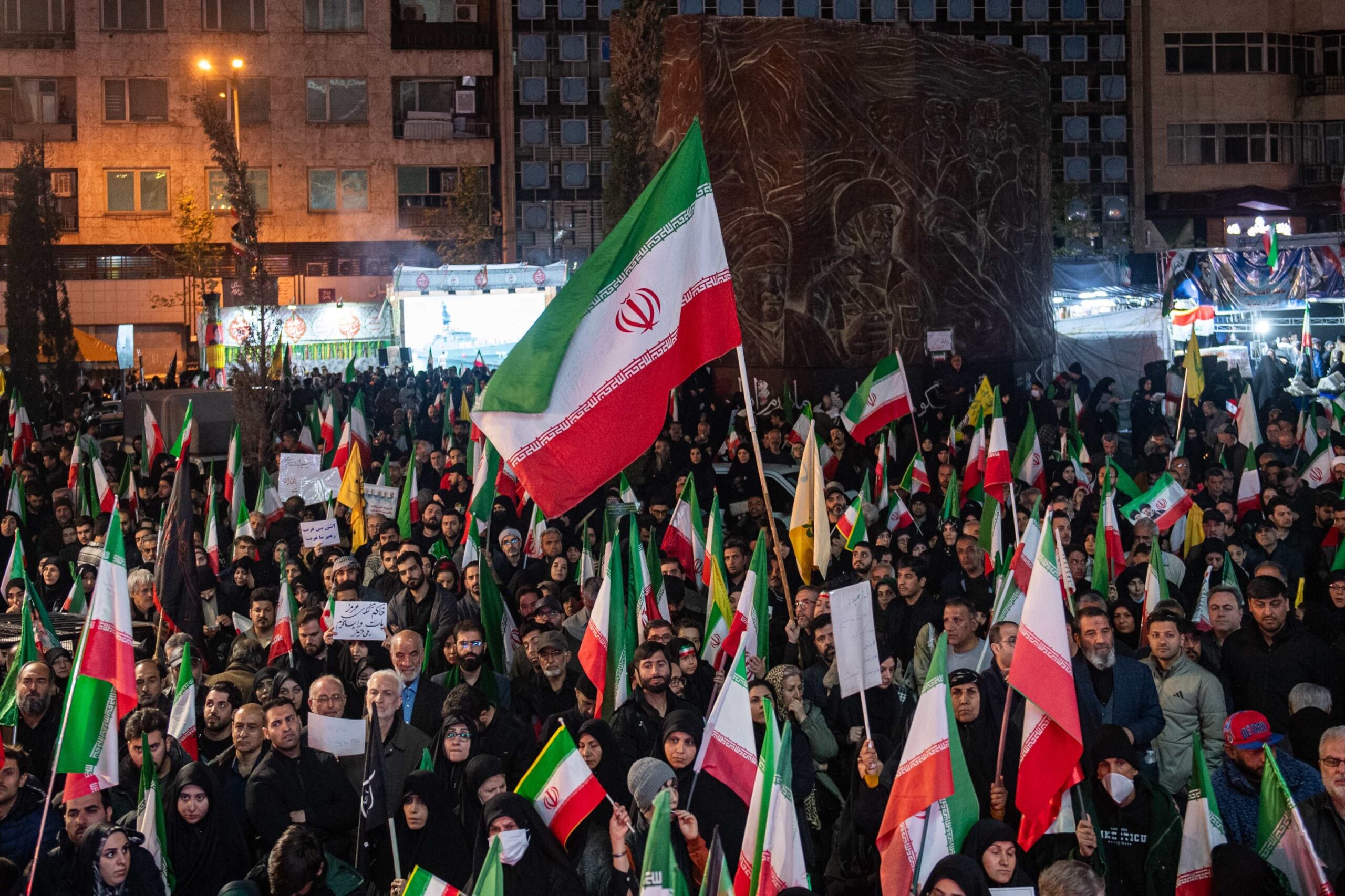
However, support for the Iran deal is not unanimous. Protests broke out in Tehran, where demonstrators harshly criticized the minister of Iranian Foreign Affairs, Abbas Araghchiand the main negotiator of the agreement, the president of Parliament, Mohammad Bagher Ghalibaf. An ultraconservative minority in Iran opposes any kind of rapprochement with the United States, advocating instead to continue the war with the country that assassinated Iran’s supreme leader.
The agreement represents an important step to stop the war and start negotiations, but a definitive agreement has not yet been finalized.
Since the declaration of the ceasefire in April, many Iranians consulted by ThePost They stated that the Iranian government and its security forces appear to have emerged stronger from the conflict with the United States. There are more paramilitary groups on the streets of the cities, arrests and executions have increased. At night, state television broadcasts forced confessions from Iranians arrested on espionage charges.
desperate for a change in a system of government that he considers oppressive, Reera, a 32-year-old sociology professor in Tehran, began to warm to the idea that outside military intervention could achieve what successive protest movements, such as the one crushed in a violent large-scale crackdown earlier this year, failed to do: overthrow the repressive government. Instead, according to her, the war seems to have strengthened the state even more.
“Patrols, armed men, street checks, arrests” are everywhere, he said. “Part of society thought that if Khamenei disappeared, the entire system would collapse immediately, but the system is not just one person,” he said. “This has created new desperation.” Since the initial ceasefire largely stopped the warIn April, human rights defenders They claim that the Iranian repression against dissent, begun during the protests, has only intensified.
Amnesty International counted 39 political executions since the start of the war on February 28, many of them the result of “expedited and grossly unfair judicial processes.” An Amnesty report, produced covertly under what the Iranian government calls “war conditions,” last month described the crackdown as a “frontal attack on the people of Iran.” Elnaz, a 35-year-old marketing manager who lives in Karaj, west of Tehran, said that since the war she has noticed that people are more afraid to express themselves.
“This war has caused the entire world to remain silent,” he said, predicting that the conflict will end up in “a spiral of silence” and that in a few years “the Islamic republic will rule without any voice of protest being heard.” Trita Parsi, an Iran analyst with extensive contacts among Iranian leaders, at the Quincy Institute for Responsible Foreign Policy (a Washington think tank that advocates moderation in foreign policy), said the war has been “a disaster for the democratization of Iran.”
In December and January, nationwide protests in Iran and the brutal government response, which left thousands dead in a matter of days, garnered national and international attention. Since the war began, attention has been completely diverted. “The War of Trump saved the Islamic Republic at one point “when it was facing the biggest legitimacy crisis in the last 20 years,” Parsi said. Ultimately, Parsi said he believed that lifting sanctions will encourage the Iranian government to reverse some of its repressive policies and improve the lives of the Iranian people. However, he warned that “it is not a quick fix.”
The war that some promised would save us only made us more miserable.
“In the long term, if you have an open economy in which the middle class and society are strengthened against the State, the path that we have seen in almost all other countries is a movement towards democracy,” he said. Isfahan primary school teacher Parichehr said she would welcome the kind of economic relief and change that would allow Iran to open its economy and become more like that of other countries in the region, such as the United Arab Emirates. However, he expressed fear that any deal that does not include measures to ensure greater accountability from the Iranian government would be unworkable.
“Many people are concerned that, even if more financial resources come to the country, the impact will not necessarily have a fair impact on the lives of citizens,” he said. Regardless of the terms of the agreement, many fear that a resumption of war is inevitable. Following the 12-day war with Israel, Iran was gripped by similar fears and, this time, little is said to have changed. Elnaz, the marketing manager, said that since Iran views its conflict with the United States as existential, there is no room for compromises that lead to true peace. “There is no middle ground,” he declared.
Reera, the sociology professor, said some people still believe that a return to war will finally free the Iranian people from their leaders. He added that some Iranians continue to call on the United States and Israel to “finish the job.” But as far as she was concerned, after having lived through the war, she stated that she would never support military intervention again. “The war that some promised would save us only made us more miserable,” he said.