
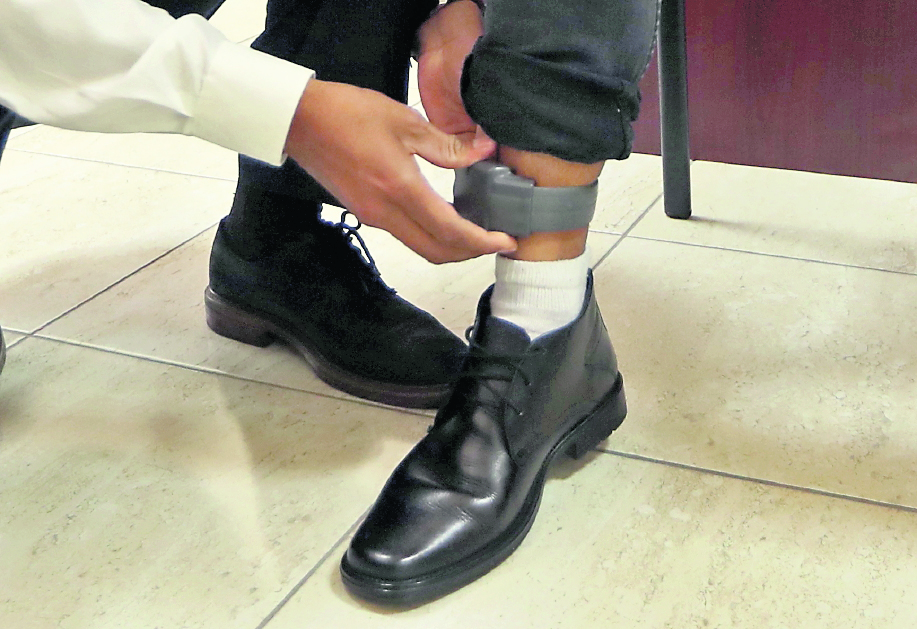
The continuity of the telematic control system will require a new million-dollar investment. The Ministry of the Interior awarded a contract for Q88.5 million to maintain the operation of electronic devices, a tool created to reduce the use of preventive detention and contain overcrowding in prisons.
However, three years after its implementation, the main challenge remains to expand its use. Since 2023, 408 devices have been placed, just one fifth of the planned capacity for the 2,000 anklets and/or bracelets available.
The contract, awarded to the company Tecnología Acceso y Seguridad, SA, includes the leasing of the Telematic Control Unit equipment and the devices used by the beneficiaries of the system.
Although the Ministry of the Interior maintains its commitment to this tool as part of the modernization of the justice system, specialists and operators agree that there are still barriers to expanding its use.
The final decision rests with the judges, who determine its application in each case, but challenges also persist so that lawyers and users are fully aware of the conditions under which telematic control can be requested and granted.
This is the second million-dollar investment made by the State to sustain the program. When the system began operating in 2023, the same company obtained a contract for Q110.3 million for the initial implementation of the service.
For Corinne Dedik, researcher in the legal and social area of the National Economic Research Center (CIEN)the continuity of the system is necessary, but the main challenge is not to have more devices, but to ensure that they are used more.
“We cannot be left with only 400 ankle bracelets in use if there are 2,000 ankle bracelets available,” he said.
The researcher considers that the success of the new award should be measured not only by the operational continuity of the system, but by its capacity to increase the number of users and expand the areas in which it can be applied.
Implementation balance
Three years after its launch, telematic control shows progress, although it is still far from reaching the potential for which it was designed.
The new investment comes at a time when the main challenge no longer appears to be the availability of equipment, but its utilization. Since the implementation of the system in June 2023, 408 electronic bracelets have been placed, which is equivalent to 20.4% of the planned capacity for the 2,000 devices included in the service, a behavior that for Dedik shows that growth has been constant, but slower than expected.
“It has been observed that the number of devices that are being used has been increasing, but it has not been an accelerated growth with high numbers from the beginning, but rather a slow increase over the years,” he explained.
The researcher considers that the tool has shown positive results, but that there is still ample room to expand its coverage within the justice system.
The records also show a marked territorial concentration in the department of Guatemala, where the largest number of activations are reported. However, there are also departments outside the metropolitan area that register a relatively important use of the system, which opens space to analyze differences in judicial application and knowledge of the tool between different regions of the country.
Barriers to expanding use
One of the aspects that has generated debate in recent years is the cost of the service. However, Dedik considers that the legislation incorporated mechanisms to prevent a person’s economic situation from becoming an impediment to accessing the benefit.
“The law precisely establishes that there is the option of carrying out a socioeconomic study to determine if the user can be exonerated from that payment. This was included to avoid discrimination or unequal treatment due to the economic conditions of the people,” he explained.
However, he considers that there is still a lack of knowledge about this possibility.
“Many lawyers and people still think that if they cannot afford the tool, then they cannot access it. I think there is still a lack of information that can contribute to not requesting access to telematic control,” he said.
In the researcher’s opinion, the main challenge continues to be strengthening knowledge about the mechanism among those who participate in judicial processes.
“I do consider it very important to continue with socialization and training to better disseminate knowledge, availability and the conditions under which this tool can be accessed, especially in the lawyers’ union because they are the ones who must advise people who are involved in a judicial process,” he added.
Violence against women: a rarely used application
One of the findings that most caught the attention of CIEN during a recent investigation into femicide and violence against women was the limited use of telematic monitoring as a complement to protection measures for victims.
The Law on the Implementation of Telematic Control establishes that the mechanism can be used to supervise security measures aimed at protecting victims of violence against women and verify compliance with restraining orders.
However, the data reviewed by the research center reflected minimal use of this modality.
In February 2026, during an evaluation on femicides and violence against women, the CIEN documented that only two devices were active to accompany security measures in this type of cases.
“We were quite surprised that there were so few cases that accompanied security measures with this tool. It can be an excellent prevention measure because it allows us to constantly verify that the aggressor really complies with the restraining order,” said Dedik.
According to official data, the Femicide and Family Courts granted 4,393 security measures between 2024 and 2025. When compared with the number of devices used to monitor compliance, the difference is significant.
“We were very surprised that the indicator was so low with respect to the number of measures granted. The relationship is quite contrasting,” he indicated.
The researcher considers that the system has the potential to strengthen the protection of victims and prevent situations of violence from escalating into more serious events, and more women dying.
“It could be an excellent prevention tool so that violence against women does not escalate to femicide or acts of repeated violence, because there is really supervision to ensure compliance with the security measure,” he said.
Other uses still pending
The legislation also contemplates the use of telematic monitoring in the final phases of serving sentences, as part of controlled supervision and reintegration processes.
However, according to Dedik, this modality has practically not been developed since the implementation of the system.
“The law establishes that it can also be applied in the last phases of serving a sentence and until today this tool has practically not been used in that aspect,” he stated.
For the researcher, this is another example that the country has not yet taken advantage of all the possibilities offered by the mechanism.
“There is still ground to cover before we can talk about a complete implementation of this law,” he added.
Benefits for the justice system
For Dedik, one of the main contributions of telematic control is that it allows supervisory measures to be applied without automatically resorting to imprisonment.
“If a person does not necessarily have to enter a prison, it is always better that they not enter,” he said.
He explained that the tool helps avoid the breakdown of family, social and work ties when the person prosecuted does not represent a risk that justifies a more restrictive measure.
“In the end it is more beneficial for society not to tear the person from their social and possibly work environment to put them in prison, especially when there is no real need to do so,” he added.
In addition to contributing to reducing preventive detention and overcrowding, it is considered that the system strengthens the control of substitute measures and represents an important step in institutional modernization.
“It is an important tool to modernize the entire justice system,” he summarized.
Seven years to enter into operation
Although the Telematic Control Implementation Law was approved in 2016, the system began to operate until June 2023, after a process that lasted almost seven years.
During that period, various contracting and awarding attempts were recorded before finalizing the acquisition of the system. Coordination was also necessary between the Ministry of the Interior, the Judicial Branch, the Penitentiary System and other institutions involved.
Subsequently, the technological infrastructure was developed, the monitoring center was enabled and the training of judges, prosecutors, defenders and operators responsible for applying the mechanism began.
For Dedik, precisely this dissemination and training phase continues to be decisive for the investment made by the State to translate into greater use of a tool that, in his opinion, still has room to grow and meet the objectives for which it was created.
“I do consider it very important to continue with socialization and training so that knowledge, availability and the conditions in which this tool can be applied can be further disseminated,” he concluded.