

Located in the heart of the temple of San Francisco el Grande, in Antigua Guatemala, the tomb of the Holy Brother Pedro, considered the first literacy and first saint of Guatemala, Hear his remains and documents that commemorate his life, marked by a deep legacy of faith, service and charity.
From 4.30 am, dozens of devotees have rowed on the outskirts of the temple, which this weekend opened its doors extraordinarily to allow the faithful to approach the place where the remains of the saint rest. Many do to thank favors granted; Others, hoping to receive a miracle.
As part of the celebration of the Jubilee Year for the 400 years of the birth of the Holy Brother Pedro de San José Betancur, visitors can appreciate historical elements such as their baptismal certificate, their tomb and the death certificate, in addition to paintings and documents that relate their life and work.
For every hall of the sanctuary of Holy Brother Pedro, the legacy of the saint is breathed, whose life transformed the social and spiritual history of the country. His grave, his relics and the testimonies of faith that surround him become the center of this commemoration full of devotion and hope.
These are some of the curiosities and historical elements that visitors can observe during their tour.
The Baptism Act, a historical relic
One of the most significant relics preserved in the sanctuary of Holy Brother Pedro, in Antigua Guatemala, is the baptism act of Pedro de San José Betancur, extended on May 21, 1626 in Vilaflor de Tenerife, where the Guatemalan saint was born.
It is an original copy sent from Spain, which records the moment when Brother Pedro was incorporated into the spiritual life, and which is considered the official document that supports his birth before the Church.
In an interview with Free pressFray Edwin Alvarado, rector of the sanctuary, explained that, although there is knowledge that Brother Pedro was born on March 19, 1626, there is no official document that certifies it. Therefore, the Church has taken the baptism date as a reference to commemorate its birth.
“Some people may say that he was born on March 19, so it is called Pedro de San José Betancur, and it is true. But, speaking of the 1626 years, there is no official birth document. What does exist is the baptism act, an original copy, as it is in the baptismal book of its parish of San Pedro, there in Vilaflor, Spain. That is why we manage to be born to life, to the Church, to the Church, to the Church. Fray Alvarado explained.
That is why the Catholic Church commemorates March 21 as the birth day of the Holy Brother Pedro, since it is the date that officially marks its incorporation into the Christian community and its beginning in the public life of faith.
Exhibition of the original copy of the Baptism Certificate of the Holy Brother sent from Vilaflor, Spain. Pedro (Free Press Photo: Esbin García)
The Catholic community and devotees of Holy Brother Pedro de San José Betancur They can live this historical and spiritual moment until March 23 at 6:00 p.m.
The death certificate of Holy Brother Pedro
After a life dedicated to the service of the people of Guatemala, Holy Brother Pedro died on April 25, 1667, in Antigua Guatemala, after having fallen into bed due to the infection of an acquired infection while attending the sick.
It is believed that his health was weakened by fasting constants, long days of sleeplessness taking care of those in need and for a feet infection that was not treated in time. He died at 41 years of age, on Monday at 2 pm, as stated in his original death certificate, which is also protected in the sanctuary of Holy Brother Pedro.
A particular detail is that, although his death occurred on April 25, his liturgical party is celebrated on April 24. This is because the 25 is commemorated to San Marcos, Apostle, and to avoid the coincidence of dates, the celebration of Holy Brother Pedro was transferred a day before.
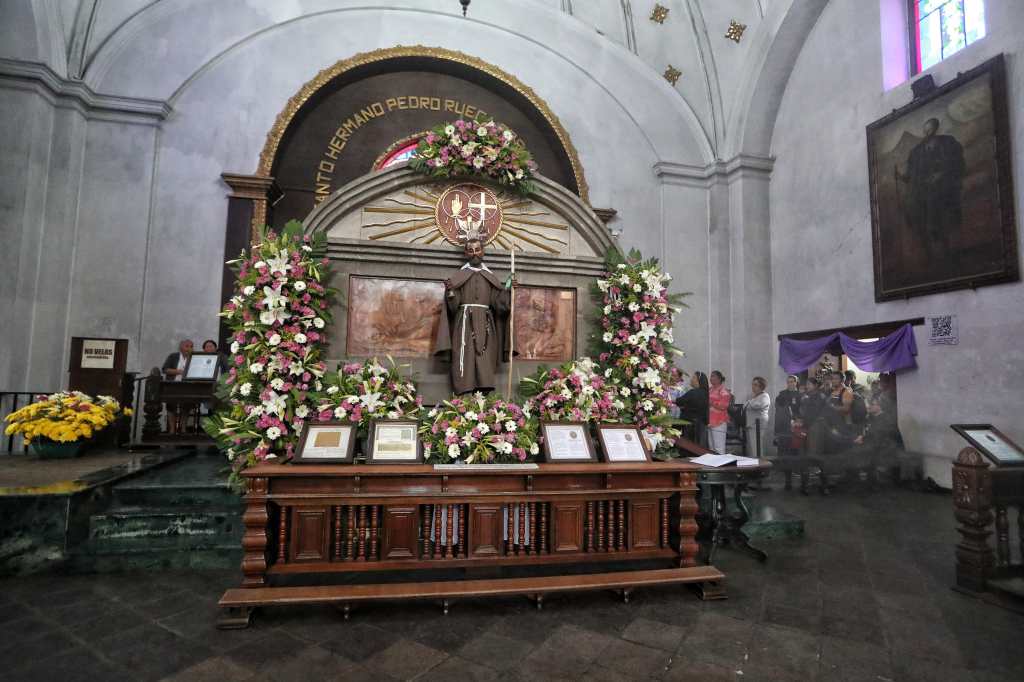
Exhibition of the death certificate and the baptism certificate of Brother Pedro. (Free Press Photo: Esbin García)
A painting of Holy Brother Pedro in real size
In the sanctuary of Holy Brother Pedro it is preserved more than a simple exhibition: the holy remains of a man who lived and died in charity rests, as well as the history of a spiritual legacy. One of those significant pieces is the tomb of the saint. Fray Edwin Alvarado, rector of the sanctuary, recounts that, after his beatification in 1980 and in the process towards his canonization, a forensic study of his remains was carried out in 1990, in Antigua Guatemala.
During this evaluation it was determined that a painting that is believed dates from the 16th to the seventeenth century preserved in the sanctuary located in the Temple of San Francisco El Grande, was made in real size. Forensic analysis revealed that Holy Brother Pedro measured 1.55 meters tall.
Next to this painting, small shoes that belonged to Brother Pedro, objects that – according to Fray Edwin Alvarado – are preserved, “reinforce the image of a physically small man, but spiritually immense.”
Visible wounds in their remains
A peculiarity that visitors can observe in the remains of Holy Brother Pedro is a perforation or cleft in his skull, which – according to Fray Alvarado – has been interpreted by some as a wound or a congenital condition, and is represented in several prints.
Fray Edwin also commented that one of the most shocking findings of the forensic study was the discovery of deep calluses in the knees of the saint, visible even in the bones, as a sign of an intense life of prayer of knees and penance. These brands can be observed with the naked eye.
“When they prepared him for his velation, when cleaning his body, the calluses of his knees came off. They were stored as first -hand relics,” Fray Edwin said.
The valuable documentation that protects the sanctuary of the Holy Brother Pedro
As part of the spiritual and historical legacy of the Holy Brother Pedro, the Sanctuary of San Francisco El Grande, in Antigua Guatemala, retains valuable documentary pieces that allow to know more about his life and work.
Among them are the songs of their authorship, compiled in the book Brother Pedro’s writings. As explained by Fray Edwin Alvarado, rector of the sanctuary, many of these phrases and reflections have a family origin.
“Many of these phrases and reflections have a family origin: it shows the influence of their mother, who also had a very particular and pious way to express themselves,” said Fray Alvarado.
The Historical Archive also protects the original letters that the saint wrote to request support in the foundation of what is now the Bethlemita Order, as well as his will and other documents that reflect his missionary life and his deep commitment to the most needy.
“An important fact is that, after his death, the official decree that authorized the foundation of the Bethlemita Order was received. This document arrived in Guatemala during the nine days of velation, and became one of the pillars for the creation of this religious order, the first of Latin American origin,” said Fray Alvarado.
This foundational decree, considered a key document for the birth of the religious order, remains preserved and is currently exposed next to the tomb of Holy Brother Pedro, as part of the commemoration of the 400 years of his birth.
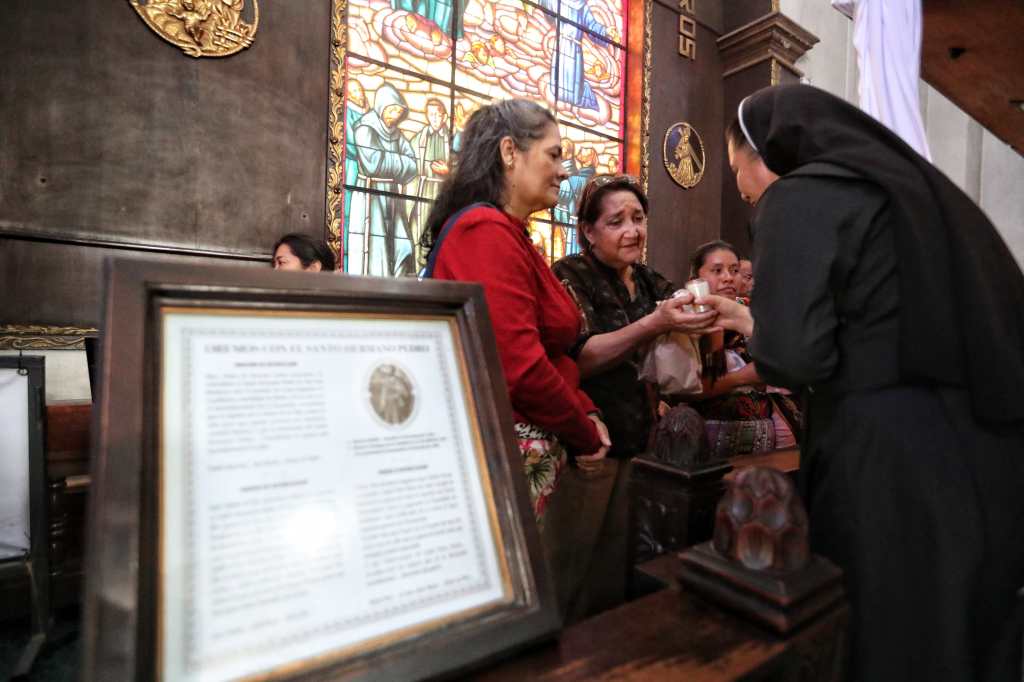
Coplas of his authorship, compiled in the book Brother Pedro’s writings. (Free Press Photo: Esbin García)
Life and Holiness of the Holy Brother Pedro de San José de Betancur
Pedro de San José de Betancur, known with love as Brother Pedro, was born on March 21, 1626 in Vilaflor, Tenerife, in the Canary Islands, Spain, his hysteria recounts that since childhood he led a simple life, dedicated to sheep grazing at the foot of the Teide volcano, where his pious and generous character was forged.
At age 23, promoted by his faith and the deep desire to serve, he undertook a trip to America, it was until February 18, 1951 that Pedro de San José de Betancur arrived in the city of Santiago de Guatemala – today Antigua Guatemala – where he joined as a Franciscan tertiary and dedicated his life to the care of the poor, sick and homeless for 16 years, until his death, according to Fray Alvarado.
Work and legacy
Brother Pedro left a spiritual and social legacy that deeply marked the story of Guatemala:
- It was the first literacy in the country
- Founded a hospital for convalescent, pioneer in its kind
- Introduced Christmas inns and births, today traditions rooted in the Guatemalan culture
- He founded the Calvary of Antigua Guatemala, the convent of Our Lady of Bethlehem and the Order of the Bethlemitas, in its male and female branches, this being the first religious order born in Latin America
Way to the altars
Fray Edwin Alvarado points out that after his death, numerous miracles began to attribute to his intercession.
In 1698 his canonization process began officially, and was declared venerable in 1771 by Pope Clemente XIV. However, the process was suspended after the suppression of the Bethlemita order in the nineteenth century.
It was until the 1960s that the process was resumed, thanks to the effort of Franciscan friars such as Fray Miguel Murcia Muñoz and Mr. José García Bauer. The efforts culminated in the beatification of Brother Pedro on June 22, 1980, proclaimed by Pope John Paul II in the Vatican.
Beatification celebration
The announcement was received with deep fervor throughout the country. In Antigua Guatemala, a pontifical mass and a procession were held that toured 84 blocks, even exceeding the traditional Holy Week processions, a reflection of the people’s affection for their saint.
Canonization: the first saint of Guatemala and Central America
Finally, on July 30, 2002, Pope John Paul II proclaimed him Santo in a massive ceremony held at the South Hippodrome, in Guatemala City, before about one million people.
Since then, Holy Brother Pedro is remembered and revered as a model of humility, charity and delivery to others, being the first saint of Guatemala and Central America.